I like to read all kinds of different websites and blogs when I have the chance, and occasionally I will read Huffington Post articles that others have shared. They clearly had a more liberal bent to them, but it was easy enough to overlook in the interest of having something to read on lunchbreaks, etc.
If I ever had any doubt that Huffpost was dragging its left wing on the ground, this little nugget removed it. Sure, it’s an opinion piece, but why not publish something opposing as well? The supposed minister who wrote this, while clearly well-spoken and rather erudite forgot to mention something that occurred to me.
Now, I am no apologist, and certainly no pastor. I have only been six classes deep into biblical studies.
But I know this much about biblical truth.
If you know God–really know him–you can feel the truth of his word when you read it. It’s powerful, and personal, and sometimes nearly ineffable. Sometimes when I read scripture, it’s almost as if the bible vibrates in my hands.
Because
the truth
resonates.
Not just in the mind, but the heart.
Also, if His book is not truth, and He isn’t who scripture says he is, then He is a sham. If He is God, then what is to prevent Him from Divinely inspiring others to record His word? If He is not God, then we are truly stuffed.
His Word, left for us, is part of both Him and His divine nature. Yes, not every version is exactly the same, but neither is every language. Yes, the King James version was commissioned, but the documents it was based on were real, with many documents of the same era still in existence.
His Word is not actually the book itself, but the wisdom and truth within.
I acknowledge the difficulty of a person who’s never acknowledged God in believing scripture is actually the word of God, but it’s equally difficult for me to imagine someone who professes faith not believing.
I believe His word is real, and though I may not read it as much as I would like to (or should), it is no less truth to me.
Without God, my life would not be worth a darn thing. Scripture helps me to walk that jagged path with a little more surety in my step.
The…minister who wrote this HuffPost article? Despite his eloquence and writing ability, appears to have lost his way. If the Word is not truth, then what does he preach from? One can only hope that his article causes little more than a Left-leaning backslapping party.
Lastly, I would say that denying truth doesn’t change it. I have learned that the hard way.
I know my wife isn’t the biggest fan of overt and public sentimentality, but something happened a couple nights ago, and I thought I’d go ahead and share it, because it felt significant to me. She’s probably used to me getting all “Air Supply,” anyway.
Plus, everyone who knows me knows I have a gooey center.
We went to bed not that long after getting home from the Rock Youth 4th of July extravaganza, and we were both tired. We lay there and talked quietly for a few minutes, and laughed over a few dumb things, and then I fell asleep holding her hand–with our entertwined hands clasped between us at chest level.
What I thought about the next day was that I hoped I got to do that when this particular love train pulls into the depot for the last time.
But I have peace in my heart either way.
My faith assures me there will be plenty of time for that stuff.
Forever is a long time.
I never thought I would be down with the optimism.
Can’t help it.
My wife is rad.
And she makes me want to do awesome things together.
My niece posted a meme a day or so ago that really made me think. It was about separating from people that hold us “back,” or something to that effect. I stared at it for a moment or two, and the next thing I thought of was that it wasn’t necessarily people that held me back at one time or another. It was the things they said about me that I believed.
They were not always true, or perhaps based in truth but executed in cruelty.
I don’t think many people would disagree our preteen and teen years truly are formative. That time is our proving ground for adulthood. We learn how to treat people. For all intents and purposes, we form ourselves from the looseness and carefree time of childhood into what we will become.
We form our self-images.
In some cases, this is a good thing—maybe in many cases. But I believe for every kid that comes out of their childhood thinking positive things about themselves, there is probably another who struggles—sometimes a great deal.
We hear the things people say about us, and probably more often than we should, we believe them. Sometimes even our friends can inadvertently say things that we wish we could forget.
We can’t.
I think it would be fair to say there are always “those kids” at the teenage level, who make it their mission to dismantle the self-image of kids who do not conform to their normality. That was me. Those kids let me know who I was in their eyes, and who I was not. At the same time, my brother had already got started on turning me into a bit of a mess.
For as long as I could remember, I heard things—these Iago-like whispers—that made it oh so clear I was not supposed to be here. I was an accident. They only pretended to love me. Things like that, and worse. And because I was young, I believed that shit for most of my adolescence.
Then I had the kids in my junior high who seemed to focus on my size. I had always been tall for my age, and became broad as well once I got through puberty. All my “classmates” could focus on was my extra “padding” in the midsection.
They said things like “fat,” “fat cow,” and one time the extremely eloquent “fat p.o.s.” It slowly dawned on me they were right, too. I knew it was possible to change that, but it seemed pointless. I wasn’t ever going to amount to anything anyway.
I was carrying that when I started High School. It would not be an understatement to say I was not one of the cool kids. We were not well off at all, and my clothes were never designer, and sometimes not even new. It shouldn’t have mattered, but kids can be more cruel than the Marquis de Sade so it ended up kind of making things harder.
I was bussed from Santee to Grossmont high school, and I remember how crappy the kids from that neighborhood were to those of us who could not afford the trappings of wealth many of them could, and who didn’t look the way cool or attractive people were supposed to.
That was me for sure. Overweight by the in-crowd’s standards. Average-looking at best. Generic or used clothing, for the most part. The “fortunate” kids were always kind enough to let me know where I fit in the scheme of things.
There was one time in particular that stuck with me–well, two. The first was one day early in the school year. I remember getting on the bus and feeling like the clothes my sister had purchased me looked pretty good for a change, and my new Payless shoes looked just like Adidas. I thought it might make a difference.
I remember one kid when I got off deliberately stepping on my shoes and making them dirty, while another berated the “Kmart specials” I was wearing. I was utterly humiliated.
The other time I was getting out of my car at the Parkway Bowl theater about a year after my mom died and I was wearing this rugby shirt I liked a lot and a pair of actual Levi’s I’d purchased myself. A carload of high school boys (football players, by their jackets) drove up and yelled “egg the fat kid,” which they proceeded to do. Thankfully, their aim was much worse than their probably beer-impaired judgment, and they only hit me once, right on the chest of my rugby shirt.
Egg the fat kid, indeed.
I’m not sure why, but when I saw my niece’s meme today, it made me think of the careless cruelty of my peers when I was the age we care about what people think the most. I so wanted what they had, because I thought I’d fit in. Maybe even get popular friends.
Instead I got labeled.
Fat.
Geek.
Pussy.
Fag.
I went against everything most guys my age were into.
I read—books and comics.
I didn’t watch sports (though we did play a lot of pickup basketball and football).
I was poor, and out of shape.
I was into drama, and men’s chorus (glee?).
The friends I did have cared not at all what kind of jeans I wore, how I dressed, or how much weight I carried.
They still don’t. Maybe that’s why I never really cared much for brand clothes as an adult.
And then there came a point where I stopped caring about my labels, and began to realize the person I was had little to do with them.
God did.
A couple of years ago, some executive at Abercrombie and Fitch made some comments about “fat chicks” patronizing his stores. He created a pretty big stink, and it goes without saying a lot of people were angry. It also made a lot of women (and men) reject their labels, and that is a very good thing. It might be worth adding that by all accounts, the A and F CEO is supposedly a bit of a troll in addition to his PhD in douchebaggery. It seems evident he is attempting to make up for whatever he feels he missed out on in his youth.
He’s going to fail, and no matter how expensive the clothes are he wears, in his heart he will always be the fat kid, or the poor kid, or the kid with buck teeth. There is only one way to find healing for those kind of wounds, and it is not through wanton buying sprees and callow and superficial attitudes toward people who don’t meet some arbitrary fashion standard.
If it weren’t for Jesus, I would still be trying to meet those standards and trying to please people who didn’t like me for who I was, and would never love me for who I wasn’t. It was and remains ridiculous.
Let me say to you now, if you live your life trying to please people by being cool, you’re going to fail.
It’s human nature to try and conform to what “everyone” is doing. We have an inherent need to fit in somewhere.
Unless the people you’re trying to fit in with know the real you—know your true self—than whatever it is you’re trying to do, or whoever you’re trying not to be, will amount to a handful of smoke.
Maybe you were once the fat kid.
The ugly girl, or geek boy.
Or maybe you were poor.
The stupid retard.
The bible thumper.
The whore, or the worthless junkie.
Don’t try to live down any of that stuff. Don’t let what people have said in the past—or are saying now—define you.
Don’t be subject to a label.
Don’t label anyone else.
Labels are false.
They lie.
While you may even be some of those things, you are not defined by that. It isn’t you. What you do (or have done) and who you are don’t have to be the same thing.
Let me tell you a little about the people I spend most of my leisure time with now. We’re a bunch of different folks. Stay at home moms. Property managers. Children’s ministers. Sound engineers and musicians. My closest friend is a pastor who doesn’t get to preach that often, but still helps change lives, mine included.
These people know the truth of me and love me in the purest sense—as friends.
That label I accept.
Friend. Along with husband, father, brother.
Lastly, consider there was a person designed for you to be before you got here. Your path to becoming that person is not always easy.
But I believe you get there not just by rejecting people who are holding you back, but by rejecting the many, many labels we are given who do not define who we are.
We are not:
Worthless junkies
Unloved
Forever broken
Stupid retards
Whores
Fat kids
Our true identity lies within, given to us by our maker. We are his children above all other things—sons and daughters. He does not make mistakes. Whether or not you believe that does not make it any less true.
I don’t think I will ever be done with revisions on this one.
There’s been a great deal written over the past few years about how the church is “losing” millenials (young people coming to adulthood around the turn of the century, the year 2000, that is) or members of Generation “Y.” Many have speculated as to the reason, but it seems to me to have something to do with the rise of liberalism and/or progressivism in both politics and the church. This is manifested in many ways, but I believe most significantly is the extreme antipathy of many young people toward conservatives for what they feel is a hawk-like view of the war in Afghanistan and the potential for war in places like Syria, Libya and Gaza. Not to mention conservative support for legislation like the Defense of Marriage Act (DOMA) and legislation against gun control reform.
There are probably lots of personal reasons people have for turning away from or leaving the church. But based on news coverage and changing public opinion, it seems to me the perceived (and sometimes actual) treatment of LGBTQ men and women by conservatives and “evangelical” Christians has had the most effect on young people as far as changing their views of the church. Recently, for instance, there have been several instances of business owners not performing services for certain customers because of their sexuality.
Of course, what people often do not discuss is that to an extent, the reverse is also true. From what I have observed and to an extent, experienced, many among the gay community have highly skewed ideas about conservatives among the straight, conservative, often Christian community. This manifests itself in several different ways. Chief among them, I believe, is the frequency with which gay people file lawsuits against Christians who are not able to do something for them because of something they either believe or do not believe. They make no secret of their faith, and it would be obvious to most folks of course they would object to supplying service to people who are in the process of doing something they object to—something that offends them—on the grounds of their core beliefs being different from that of the gay folks bringing the lawsuits.
So why do they approach businesses they know will probably not render them services? Is it because they have discovered someone doing a perceived wrong and they want to right it?
Is it because they’re looking for a nice payday? Or maybe because they want to destroy a business operating apart from their own agenda?
Do they have an agenda? Is it “tolerance?” If so, of what?
It may not always be so, but these cases always smell a little bit like an ambush. It often seems as if these Christians who object to supplying food or services to those Gay people getting married or whatever the need happens to be, are targeted specifically because the person(s) making the request already know what they will do and they wish to make an example of them.
For my part, I don’t know if I agree with denying services to people as a form of protest. I am not sure what I would do given the same situation as some of these folks, but I think my inclination would be to make the best cake I could, and do it for the glory of God. It’s a bit of a sticky wicket. Does providing services to someone practicing a lifestyle someone else does not indicate some sort of heresy or blasphemy? I don’t know.
I do know the situation is ugly both ways, and certainly seems as if it could be mitigated by a little understanding from both “sides” of the issue. After all—is freedom really freedom at all if it can only be interpreted and exercised one way? Either way?
So, to be clear, I believe what Jesus and others say in the bible regarding sin. I believe that it is rampant in the world, and we are all covered in it. But I also believe in God, in Jesus, and in his sacrifice on behalf of the world and everyone in it. Not just everyone who believes, but everyone.
Lately, the issue is no longer simply that of “gay marriage.” Also coming into the ring is that of recognizing people with…alternate gender identities. Can they dress a certain way, or “identify” a certain way without “persecution?” My personal thought is that hating your “original” genitals does not mean they aren’t the ones that are supposed to be there. I do not believe that God makes mistakes. And I do not believe that, say, removing your hood ornament makes your vehicle something other than what it is. But it doesn’t excuse being a jerk to people simply because you think they’re doing something they shouldn’t.
Still, there is this: over the past year or so, there have been several incidents where young people with gender identity issues have been persecuted in their own way by other teens who are not in the midst of gender identity issues, and have consequently taken their own lives. This is real, and sad, and terrible. I think it’s true that few people can be more condescending, ruthless, and just plain cruel than one teenager feeling superior to another.
With the advent of people being much more open about how they identify regarding their gender (among other issues), has also come the same cruelty teens are often made to endure. The current Bruce/Caitlyn Jenner “controversy” is a great example of that. I believe that’s because people are often afraid of that which they do not understand. Gender identity that does not conform to what people expect based on the “actual” rather than perceived sex of the individual in question with the “non-traditional” identity is really pretty hard to understand, especially to people of faith.
We just don’t understand it. If you find yourself with a chromosomal structure that says you’re a man, well…you are. Or are you?
Part of that issue is that we believe God is perfect, has a perfect will for our lives, and does not make mistakes. Identifying as a gender opposite from what you are genetically seems like putting a “my bad” on God.
I can’t think of an instance where that happened, biblically.
So here we are.
Those with “alternate lifestyles” are offended because many, many Christians do not recognize their desire to be married as valid, or consider their lifestyle choices simply that; choices. They think those living in the “alternate” do whatever they do or think whatever they think because they are sexual or psychological deviants. That is probably no more true of gay people than straight people. There are creeps and freaks everywhere. That kind of deviance transcends any type of sexuality, I think.
Many of the people who share my faith also share a view that (and I am not speaking solely of the loathsome Westboro Baptist “Church” here) homosexuality and gender identity issues are chief among sins. They will be what will ultimately bring down the country, the world, and bring about the return of Christ to wreak vengeance on a gay-loving world. Or something like that. I can only speak for myself, but as a believer, I don’t really believe that. I don’t because it isn’t biblical. Sin is sin, and it’s all black against the purity of Jesus. I do not believe that being gay is any worse than anyone else’s sin. I’ve struggled with lust and addiction my whole life, and each of those in its own right is just…bad when you hold it up against one who never sinned at all.
And.
People talk about the gay “agenda,” and while there may be some gay men or women who seem to have a fondness (and no small amount of skill) for springing legal or legislative booby traps on unsuspecting business owners who also have strong ideals about faith and biblical principle, it does not mean they are trying to turn the world gay. They aren’t drinking the blood of hetero people and making more fabulous blood suckers. No. And I believe that is where the problem lies for so many believers.
We aren’t doing it right.
Often, the approach of my Christian brothers and sisters toward gay people—both at gay events and in other forums, such as online, in newspapers, magazines, etc.—is to let those men and women know in no uncertain terms what fate awaits them should they choose not to change their evil ways and repent. Seldom–if ever–mentioned is the true message of Christ. He loves them, just as much as he loves me. He died and rose for them, too.
We are supposed to love in the same way. Love God, and love others. By this all will know we are his disciples. If we love.
Love God, and love others as you would love yourself.
The problem that I have now—and have for many years—is that approach taken by so many standard-bearers for Christ sounds nothing like Jesus to me. Jesus didn’t tell his followers to condemn. He told them to go and make disciples of all nations. He told them to love their neighbors. That doesn’t mean love their sin. It doesn’t mean approve of it. But it also doesn’t mean justify your own by holding it up against something you find offensive. Hold it up against Christ if you need perspective.
It just seems to me that spewing vitriol at people does not let them know a loving God exists, a God who is in the business of deliverance. Not to mention that if I ignore the plank in my own eye, I am also sinning before God.
Let me backtrack a bit—all the way back to the very early 1980s.
My first encounter with a gay person was in the 8th grade, shortly before I moved up to high school. I wrote about that day a while back here. For those of you younger folks, homosexuality wasn’t something much talked about then. It was a different time, in almost every way. For my part, and also for many of the kids I hung out with, the word “fag” was tossed around almost haphazardly, without any concern for what it meant (many of us didn’t have anything but a rudimentary understanding of what homosexuality was, or how it was practiced. I include myself in that number).
We just said it, and it was almost a…good natured insult. Never considered was the fact that it could have been hurtful to anyone. It was just something we said. A lot.
I still regret what happened that night in my friend’s backyard, and I probably always will, to an extent. I’ve asked God’s forgiveness for my part in it, and I wish I could find the young man we hurt and ask for his, but that is not to be. Believe me, I spent a considerable amount of time looking.
So what has happened since then is that I have come into contact with a great many gay men and women at various jobs, and at the junior college I attended back in the 1990’s. With each encounter—and with each friendship developed—I began to notice something.
Each one of these men and women were people just like I was. They ate, and slept, and got dressed, and showered, and pooped. The only difference I saw was that they were drawn to people of the same sex and I was not.
We have a lot of untruth we learn throughout our lives we desperately need to unlearn. It’s the same for the gay community. They’ve got a lot to learn about Jesus, and Christianity, and Christians.
The gay people I have known over the course of my life were all involved in monogamous relationships at the time I knew them. They loved the people they were with, and in many cases had been committed to them alone for long periods of time. I worked with one lesbian couple that had been together for decades—almost as long as my parents were before they died.
Another thing to consider is the tendency of many gay people (not to mention the unquestionably liberally-minded media) to single out Christians, conservatives, and the “religious right” as chief amongst their oppressors, in a world that otherwise loves and supports the LGBTQ lifestyle and practices. The truth is, in many parts of the world (including the parts practicing Islam and Orthodox Judaism) homosexuality is condemned in stronger words than most Christians use, and gay marriage isn’t mentioned at all. That typically is not discussed, though.
It would prove that it isn’t just straight, white, followers of Christ who feel that to conform to the status quo, politically correct idea of modern normality is to compromise what they believe.
No one should have to do that.
Recently, the terrorist group ISIS (or ISIL) has began throwing gay men (and those they suspect of being gay) from rooftops in Iraq. Then they post merry, see-what-you-get posts on social media, playing up their contributions to keeping Islam true. They’re murderers, plain and simple.
It’s a little more complicated than that, though. This is certainly a multi-faceted issue.
For example, another thing I do disagree with is the tendency of late for LGBT people to liken their quest for what they call “marriage equality” to that of the struggle African-Americans faced during the civil rights movement of the 50’s and 60’s. Yes, they are fighting for what they deem a right they are being denied, but of the states who are denying LGBT men and women the right to use the word “marriage” to describe their unions, I would submit that many—if not most—of them are doing so based on the definition they have to work with on what marriage is—which for a great many conservatives and those on the religious “right” means the union of a man and a woman. While that is how I would personally define the word as well, I would do so while taking the following into consideration.
What has changed in my heart over the years (and this is way before I became a believer) was that I no longer cared about whether or not these people wanted to do the same things I did with the people they were involved with. It occurred to me it was none of my business. It still isn’t, and I still don’t care. I wouldn’t want them to try and peek into my bedroom, either (if it was up to me, I would always keep the light off—bald headed and middle aged white dudes carrying a little extra in the midsection are not exactly Da Vinci sculptures).
I’ve dealt with and related to gay men and women on a personal level, based on how they treated me and others and not who they slept with (or didn’t). It worked out pretty well, and I made a couple of good friends over the years.
One of the things that gave me the most food for thought was seeing the Larry Kramer play The Normal Heart back in the early 1990’s. It was a college production at SDSU and I remember they had this display set up in the lobby with cast pictures, pictures of the author, and I think sections of the AIDS quilt. This was around the time of the first season of MTV’s The Real World, which featured a gay cast member (yes, I watched the show). He was supposed to appear and speak at the play, but he died of AIDS shortly before it opened.
Anyway, the play got me thinking of gay people a little differently, at least regarding the way they were sometimes treated back in the early days of the AIDS epidemic. They didn’t have many rights regarding their partners–certainly nowhere near those rights afforded straight couples. And nobody seemed willing to acknowledge AIDS with the seriousness it merited, nor recognize how widespread it actually was. It didn’t seem that fair to me, even then. Yet it was what it was, and I had no intention of becoming any sort of activist. It wasn’t my issue. Still isn’t.
But.
When I came to belief in 2000, I was in a place in life where I didn’t work with or know anyone who was gay (that I knew of, anyway). I began to grow and deepen my faith, and it was so interesting to see that the Jesus I came to know through scripture and discipling was not the same one I’d heard about over the course of my life before knowing him.
In the course of time, I became somewhat involved with a young woman I worked with, and we began to spend time together with a group of friends of hers—most of whom were gay men.
I did not make a secret of my faith, and they respected it. I treated them just like I did everyone else, and I began to notice something the more time I spent with them. The gay community—at least to the extent of my involvement and casual friendships with these men—was way more of a community than the straight people I’d hung out with prior to that. They supported each other unconditionally, and seemed less interested in judging themselves and others than they did in simply living their lives. I got a little tired of the music these particular gentlemen favored (for pity’s sake, there’s only so much Missy Elliot a person can listen to), they were mostly really good and really friendly guys who liked to do different things than me.
I didn’t preach to them, and they didn’t try to convert me. I was more than willing to talk about any aspect of my faith they wanted to hear about, but I did not shove hell down their throats, either. I just tried to love them the way they were, to the best of my ability—even if I didn’t understand their lifestyle—It just didn’t seem to fit with the way we were made. But I could let that slide, for the most part. They didn’t share details of what they were doing in their relationships, and neither did I. So we had a mostly very friendly relationship, each of us understanding we were different, and that—for the most part—was OK. And the truth is, this particular group of gentlemen was a lot of fun to hang out with. If I had a dollar for every time I told someone “I’m not gonna wear that,” I could probably pay off my house. But that’s neither here nor there.
One time in particular, one of them told me, “It means a lot that you’re here. I don’t think anybody’s used to that with people like you.” I assumed he meant straight people at first, but then I realized he meant Christians.
I told him that I just loved God, and that scripture says I’m supposed to love people, too. They were gay, but they were no less people than I was. He smiled and gave me a hug.
Eventually, though, things began to change a little bit, and I started to struggle with some of the things I saw. It culminated in an evening where the young woman I was involved with and I were at a party where we were the only straight people, and things started happening around us. Very quickly, it started making me feel really uncomfortable, and I told the girl that I wanted to leave. It got to a point where I could no longer balance what I believed versus what these men did—mostly because I was being confronted with it in a way that got me a little weirded out, to tell the truth. Although it’s also worth a mention that extreme PDA from straight couples does the same thing for me.
I think it would be better if folks kept that stuff to themselves. Nobody needs to see you demonstrating your affection for your significant “other.” Seriously.
That evening’s adventures certainly weren’t in the privacy of anyone’s bedroom, so I no longer had the luxury of not being involved. My…whatever she was didn’t feel the way I did. That was the night we decided to “take a break,” which we never recovered from. There have been times when I wondered what would have happened if things hadn’t gotten so crazy that night. Would God have convicted me in some other way? I don’t know. And with things being as they are now, I can’t imagine wanting to change anything or go back. Yes, it ended up being a painful end to my relationship. Perhaps that was what it took to refine my heart.
In any case, after the party that night, I didn’t spend much more time with the group of guys, as I didn’t spend much more time with the girl—not any more, actually, outside of work.
It was five years later before I was involved with anyone else, and that was with the woman who would later become my wife. As we grew into our relationship—and later our marriage—it was around the time all the gay marriage propositions were going through the process of becoming law (or not). “Marriage Equality,” and all that.
I hadn’t thought much about the fact that gay people couldn’t (or could) be married over the course of my life prior to that time period (not since viewing The Normal Heart, at least), so it was interesting to see all of the various things on the news, including the Chik-Fil-A controversy of couple years ago.
It was interesting—and I felt a little conflicted inside—because while so many of my fellow Christians were up in arms about the potential legalization of gay marriage, I just…wasn’t. I didn’t see the point of marching on Washington or anywhere else. It wasn’t going to convince anyone of anything—it just made the people involved look bad.
I knew what the Bible had to say about homosexuality, and I agreed with it. But I also did not have a troubled heart about any of those people who wanted to get married. It didn’t matter to me what these folks wanted to do in the privacy of their own homes, and it seemed fair enough that they should be able to marry, if it made it easier regarding insurance and benefits, etc. I never felt that if they were able to marry it would threaten the sanctity of my own marriage. How could it? How could two men or two women marrying each other make my own union any less holy in the sight of God?
What did occur to me, though, was to wonder if all these people who complained, and protested, and cried out about how gay marriage was a danger to the family felt the same about divorce? Why is it we never see news stories about millions of people marching to protest how common arbitrarily ending a marriage has become? God is also very clear how he feels about divorce–perhaps even more clear than about gay marriage—which I never found a specific reference to. And while all these people were spouting off about how a word is defined, it occurred to me to wonder about how a marriage is defined? What does it mean to these people?
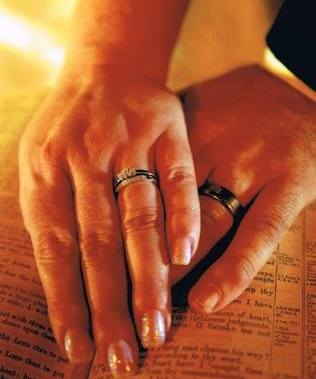
Certainly, I am not trying to say that divorce is never the right course of action, because sometimes it is the only course of action. It’s just that people are often so…fickle about it. The statistic you hear all the time about 50% of marriages ending in divorce? I believe it. Why wouldn’t it be true? It seems that few people understand what a covenant is these days. To me it suggests a sacred promise, and the rings my wife and I exchanged are a symbol of that promise. In short, I got married to her because I wanted to, because I knew I didn’t want anyone else, ever.
And on Valentine’s day a couple of years ago—I think I realized what marriage really was. It’s spending the night before Valentine’s Day in the ER with your husband, while he yells and pounds chairs and walls in his pain.
It’s spending the day itself in a chair next to his bed, and praying for him. It’s holding his hand and making him think of other things.
It’s sleeping (sort of) sitting up rather than going home, even for a little while.
It’s devotion to the person with whom you made the covenant, and that is what my wife showed me those two days. It made me love her all the more, if such a thing is even possible.
So to recap.
While I understand the biblical reasoning behind the stance so many take on whether or not homosexuals should be able to marry (based on the “biblical” definition of what marriage means), the conflict I feel comes from feeling like if people are devoted to one another, and are willing to make a covenant saying they are going to mean it for the rest of their lives, it’s hard for me not to want to just let them. Even if I don’t agree with or practice the same lifestyle they do.
Also, a while back, my adopted state of Arizona has passed (and sent to the governor–who vetoed the legislation) SB1062, a law that in essence allows people who refuse service to someone a defense (‘deeply held’ religious beliefs) in the event they are sued for discrimination or something of that nature. Of course, while legal recourse may ostensibly be what the law is about, the unspoken subtext is that it would also give others what they feel is license to treat gay people and their potential business in an unfair and discriminatory manner.
I believe that is it, in a nutshell. It is also what has millions of gays and pro-gays in such an uproar once again. They’re crying foul, and likening the legislation to the old Jim Crow laws from decades ago. While that may be a much lengthier discussion for another time, it does seem to me that while the “Jim Crow” battle cry is closer to pro-gay hyperbole than anything else. There is, however, a great deal of potential for discriminatory ugliness with this law, because people are people, and prone to do bad things with ambiguously worded legislation such as this.
With all that in mind, I think perhaps it is not just what some Christian folks are saying, but how they’re saying it. The arguments are the same, and probably always will be. Scripture decrying homosexuality is referenced, and gays along with supporters throw up scripture they feel counters their Christian counterpart’s efforts in the same regard. It gets uglier all the time, and nowhere on either side of the discussion is the real message of Jesus referenced.
It seems like this to me: if the bible is true, and it tells us that God is love and that all people will know we are the disciples of Christ if we love one another, then how are we showing the people who do not know his love the face of Jesus by so often treating them with open hostility? Same for gay “Christians” who do understand how people can still interpret the bible literally, and who seem to be all for prosecuting people defying their own deeply held beliefs.
There is definitely more than one side to this coin. How does feeding gay people fettucini alfredo or making a wedding cake for them make you a participant in whatever sin you feel they’re committing? I mean, I get it, but I don’t agree.
The problem is the wording and the design of the legislation, and I wonder sometimes if that was an intentional, CYA move on the part of the legislators. If so, we have to think about how this legislation is like (or could be like)…giving people already inclined to do so the right to treat others shabbily. There may be a place for some similar type of legislation, but this particular law is not going to go over well, not with the social climate surrounding this issue what it has become.
For my part, I can’t do it anymore.
I can’t treat people that way, and I never really could. Maybe some of it is my California-ness regarding gay people carrying over into my life in Arizona, but it’s really more about not wanting to feel like I’m any better than anyone else because my sin is different. I am not better than anyone else. I am the same. In my dotage, I’ve found it so much easier to treat people kindly. I would rather make them their food or a cake or floral arrangements, and then tell them God loves them and died for them, then let Him do the convicting.
I want people to know the Jesus I do. Whether they’re gay or straight or…whatever, I want them to know him, and know how he feels for them and what he did. I do not now—nor have I ever—felt my marriage (or any marriage) could be threatened in any way by who else can get married.
I wonder, though, how many gay men or women are known by the folks protesting gay marriage?
I also wonder how many Christians are known by gay, bisexual, or gender conflicted men and women?
If we don’t know each other, how can we expect anything to change in either direction?
Jesus talked to people. Walked with people. Ate with them. Probably fished with them, and laughed and drank and danced. I believe that in the end, the Eternal Kingdom will not be filled courtesy of those who spoke out against the things God hates the loudest—those who shouted condemnation from every rooftop. I think souls will quietly slip in thanks to the people who have shown them the most love, who have shown them Jesus.
To that end, because I am loved, I will try to be loving. I will choose to show people the Jesus I know by telling them about what he’s done in my life. I will tell them about how I am incomplete, and wounded, and broken, and still sin, but am loved in spite of the things that queue up to keep me from Jesus. I will explain what scripture means to me as I understand it, and I will tell people what I think if they ask me. If I love Jesus like I say, I owe them the truth.
I just have no intention of shouting it at them, or telling them God hates them because of their sin. Brand me a heretic if you must, but I feel that if God hated people because of their sin, he would hate all of us equally. And he would not have redeemed us from anything.
You don’t die for people you hate.
And to see so many people caught up in the definition of a word and how it threatens them rather than simply getting to know people and telling them about Jesus just doesn’t make any sense to me. I can’t understand how telling people they’re damned for what they do in their bedrooms is going to show them the Jesus I know that has changed my life and could also change theirs.
To be clear, once again, I am aware of the mentions in the bible of homosexuality, and that it is addressed as sin—just not by Jesus. While it is true that God hates sin, it would be errant—once again—to imply that he hates homosexuality more than any other type of sin. And that he hates homosexuals more than anyone else. Sin is sin. If God hated homosexuals, he would also hate every other type of sinner, and probably all Christians. The bible doesn’t say any of that.
Homosexuality is not something I indulge in, and whether or not I “approve” of it does not really even matter. I think the bible makes it clear what God thinks of homosexuality and what it entails, and I acknowledge the punishment for it is the same as any other sin—all other sin. Omission of mention by Jesus is not the same as approval. While Jesus himself may not mention homosexuality specifically, he did come in fulfillment of Old Testament Law, and prophecy, not to nullify it. I think where we go awry is when we start classifying sins, and justify ours as less terrible than homosexuality.
It isn’t.
No one is righteous, no not one. “The heart is deceitful above all things and beyond cure. Who can understand it?” (Jer 17:9)
Certainly not me.
We’re all different, but we are also all the same. We need God.
We need Jesus if we are to be freed from our chains and our sins. God knows it, and Christians do, too. Yet if we can condemn someone else for what they’re doing, then we don’t have to think as much about what we’re doing. All of which means that we can take comfort in our own perceived righteousness, while we decry the unrighteousness of gay men and women as if it were anything different than sins that we have committed, now, and throughout history.
Take a look at Matthew 5: 27-28. Go ahead. Read it and come back. Still here? Good. Let me repeat what I said before. Sin is sin. No one is righteous, no not one. How can I justify condemning a gay person with my own words, while justifying my own actions as a lesser sin. To God, they are the same. The punishment is the same.
Let’s talk about those Old Testament laws for a few minutes. You know the ones. Many people will talk about how scripture also mentions other things as being sinful that people don’t seem to care about anymore, like eating shrimp and other sea creatures for one example (take your pick, there are many others). They will tell you that those old laws—like the ones that condemn homosexuality as well as other sexual sins—do not matter or apply anymore, because the world is a different place. That’s partly true, and I’ll get back to that in a bit.
Those laws again, from the Old Testament. Taken specifically, there are three different types.
Laws pertaining just to the (ancient) state of Israel. They are pretty specific.
Also for consideration are ceremonial laws (many pertaining to sacrifice, and diet, and things of that nature), which were superseded by the New Covenant, fulfilled in the person of Christ.
Lastly, moral laws. It is only the moral laws of the Old Testament which remain and are held as truths by most Christians based on the validity of the Ten Commandments. I won’t go into every piece of scripture here, but at least to address the dietary laws and some of the other laws that seem to apply mainly to those of the Jewish faith rather than Christians: take a look at Mark 7:19, Acts 15: 5-29, etc.
Of course, if one does not hold the Bible as truth, then this would make little sense. And there’s the rub.
Then Jesus enters the picture, and everything changes.
As believers, we are called to share him and his truth with people. So while the biblical principles of the Old Testament make it clear how God feels about all different types of sin, there is hope, and in a world that seems to have so little, that is indeed something.
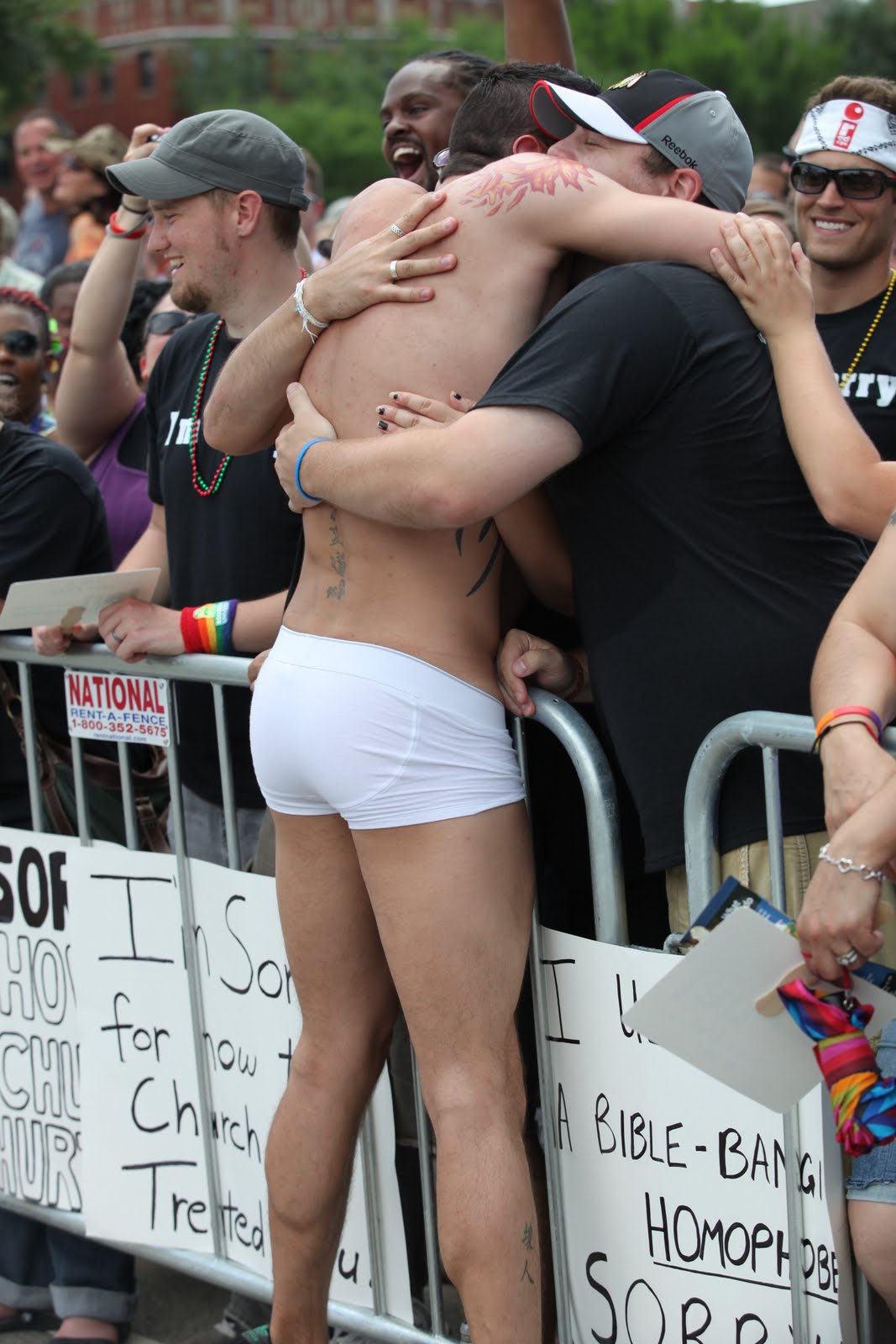
I posted a picture on Facebook not long ago I’d seen online of a group of Christians (mostly men) at a Gay Pride event, and they were holding signs and wearing shirts that said “I’m sorry.” They were apologizing to gay people for the treatment they’d received at the hands of standard bearers for Jesus. In the picture I posted, a gay man in great physical condition wearing tighty-whiteys gripped one of the shirt-wearers in what looked to be a very emotional bear-hug.
I thought it was a great picture and that it was a great way to actually show Jesus to people who needed to know him instead of just telling them they were on the Bullet Train to hell.
I got a bit of an ass-chewing from a couple of people to the effect that treating gay people as if their lifestyle was OK was the same as personally condoning and supporting it, and that wasn’t right—as if because I was a Christian, I should tell them they were going to hell. Never mind all that “love your neighbor” stuff. I want to tell people about Jesus, and I will tell them about sin. I just feel the right thing to do is let them know they are loved first.
I can’t convict someone of any sin, and I wouldn’t want to if I could. Jesus does that. And it isn’t my function, as a believer, to punish people for sin. Let him without sin cast the first stone?
That ain’t me, man—I’m a mess.
I’d rather tell someone I’m sorry, then hug them and tell them Jesus loves them.
I will leave the condemning up to God.
And if by some chance I came across the former Bruce Jenner or anyone else like him, I would do my best to simply say hello, and wish them a good day, just like I would if I met you.
Most of my adult life, something has bothered me. Enough that when I hear other people talk about it, it stirs me up quite a bit.
What’s going on with men these days?
The implication, of course, is that men don’t act like men anymore. Many see them as emasculated because they do not conform to how a whole bunch of people think a man should act.
How is that?
Based on stereotypes that have at least some basis in truth, men should be hunters, not gatherers.
They should always be willing to fight for things, and people. Yes, that does include actually fighting on occasion.
They should be strong, and strong-willed. They should never struggle with self-expression.
They should leave the nurturing up to women.
Cooking?
Nah. Maybe pancakes or barbecue, but nothing much else.
I suppose it’s true enough that men no longer conform to past ideas regarding manhood, fatherhood, and husbandhood the way a great many people think they ought to. They may lead, but by example rather than with an iron fist.
They may fight, but not always with fists (though yes, there could be a time when that sort of thing is called for. Or deserved—because there are people in life who desperately need a whuppin).
They may hunt, and provide, but not with a 30-.06 or a spear.
I guess I’ve always felt like one of those men who aren’t like a lot of others. I enjoy watching sports, but because I have a theatrical background, I also enjoy watching plays. I also like oldies as well as metal. I like Christian-themed music, too.
I like to cook, and I think I’m pretty good at it.
I don’t think I know everything, and I am not afraid to ask for directions, or help.
I have a hard time suppressing my emotions, and consequently, if things upset me in a particular way, I can get emotional.
I absolutely love talking to my wife about anything and everything. I love her and I always will. When I said ‘til death do us part, I meant it. So I hear men make mean-spirited jokes about their wives and it ticks me off.
Maybe I’m not normal—I don’t know.
A few months ago, I was on a jury panel, but I never got past the selection process, though I did get far enough to find out what the case was about: a local former teacher had been accused of 20 different counts of several child-molesting related events. It was so bad that a handful of people were dismissed from the jury because they didn’t think they could handle hearing testimony, or seeing evidence—some of which would be “examples” of various items witnesses had been shown.
Some thought they did not have the ability to render a fair opinion.
What I noticed was that when we walked in the courtroom, the defendant was standing there looking at everyone who came in with this little smile on his face. I didn’t get how anyone in that courtroom could smile.
Or how any man could refer to himself by that title and wreak the emotional havoc on these little boys emotional lives that whoever perpetrated these crimes likely did. I thought of my own limited experience with such things and the lifelong cracks in my own psyche it caused me.
I looked at that man—without even knowing if he was guilty or not—and wanted to choke him until he turned blue.
Never got the chance to be even questioned. About 40 of us were dismissed by the judge after a large enough pool was selected.
In spite of my own childhood issues thanks to some inappropriate family behavior, I wanted to be selected for the jury. I don’t know why, except to say that I wanted to be a part of justice for a person who’d been harmed in that way. Justice like I hadn’t seen myself.
Then I came home, and as my dogs and children were scrambling around the back yard, I sat on the patio and scrolled through Facebook, and I found this video, taken from a Poetry Slam competition. The young poet himself had been scrolling through Facebook much as I was, and had his childhood rapist referred to him by Facebook as “people you may know.”
Here is a video of his performance of the poem. I’ll tell you a little about what I think of it afterward.
The first thing that occurred to me was that I did not doubt this young man’s authenticity. At all. Perhaps names and situations were altered slightly (as things often are with art), but the pain he voiced from the depths of his hurting soul was as real as real can be.
There was a line where he says “no one comes running for young boys who cry rape.”
I think that’s probably true much of the time. Because that shouldn’t happen to boys. I would imagine there are people out there who think it can’t happen to boys. Because they should be able to fight back. Otherwise they wouldn’t be men.
The poet says at the end when questioned by his brother about that very thing (fighting back), “I am, right now, I promise.”
He fights back every day. He reminds himself of the people who love him, and who he loves. He reminds himself that he loves…himself. It may sound weird, but it makes sense.
Especially if you have a “wolf,” which is how he refers to his assailant. One of the worst things victimizers make victims feel is that they aren’t worthy of anything, especially love.
I may not have an assailant in the sense Kevin does, but I do have a wolf.
Sometimes, that wolf is corporeal, with hair, and bones and teeth.
Other times, he is ephemeral, with gossamer threads of my bruised soul and (formerly) broken heart hanging from his fingertips like he just brushed through a spiderweb.
Gone from my life (for the most part), but sometimes the wound opens yet again, and I really don’t want it to.
I don’t want to choke him (like I mentioned of the defendant in the trial–I’m not that kind of man), but I don’t want to have him over for a barbecue, either.
Forgive? Certainly, I can do that.
It isn’t the same as forgetting.
That’s impossible.
And while Jesus has given me life, and family, and hope, and a better way to live, I am not able to forget.
I’m not a poet (and I know it), but I believe God has given me an outlet to bare my emotions when such is necessary.
To give voice to my ire, my confusion, and to tell other people about the amazing and impossible things God has done in my life.
I do not doubt for a second, I would not be where I am today if my heart did not belong to him.
I think of two large scarred and callused hands a softball’s width apart. Between them is a torn and bruised piece of muscle—a gray lump of flesh.
The hands move about it slowly, molding, massaging. Giving warmth.
The heart begins to change. The gray fades, and eventually the heart takes on a deep, red…pulsing appearance.
Yet I am human, and sometimes the gray comes back, as it partially did when I watched the “People You May Know” performance video.
My fight is different than Kevin’s, but it is still a fight. I don’t struggle with depression anymore, not really. The battle is with my nature.
I have been delivered from my sin, it’s true.
But I am human.
Sometimes, it’s easier to go gray than ask those hands to hold your heart all the time–which would probably make things easier.
I am human. I make a lot of mistakes.
Yet because I have experienced redemption, I know that healing is there to be had.
My wounds may not go away forever, but the blood of the carpenter gives me more perspective than I ever had before I knew him.
Perspective to see that my scars aren’t going to kill me, because his wounds cover them.
Perspective to know that my wolf was probably acting out of his own pain, out of his own wounds. I could have been anyone.
Perspective to know that the comfort I received through healing of my own injuries can also comfort others, should they choose to hear and believe.
Maybe that’s even why certain things bother me. My wounds may not totally close, but that’s for a reason.
It’s how I can be used, perhaps.
Anyway, it’s how I have been used. God has also given me the ability to talk to people. I don’t know why, but they trust me, and are often willing to share fairly quickly.
Maybe that’s you, too.
Maybe you have a wolf.
Maybe you have scars.
Maybe you’ve never said his or her name out loud in context with your brokenness.
I would encourage you—no, implore you—find someone you can relate to in a personal way. A friend, maybe a pastor. It will probably be different for everyone.
Talk to them. Tear the hurt that’s blocking you from healing into pieces and talk to someone. Find a way to express what you’re feeling. I don’t know what that looks like for you. For me, those people looked like a guitar-playing, red-headed Irishman and Pastor from Pittsburgh and a Youth Minister from Yuma, Arizona.
I don’t think that’s a coincidence.
Like mine, your healing will probably not come in an instant. But it will come.
I promise you.
Like the man in the video, you may have to write a poem or maybe a song every day to remind yourself why you fight.
That’s ok, and worth doing.
Let me leave you with millennia-old words from the book of Isaiah, Chapter 42:3:
A bruised reed he will not break, and a smoldering wick he will not snuff out. In faithfulness he will bring forth justice.
Always, he will bring forth justice. It would be so much easier if the justice of man and God were the same. Healing would not be such a process.
But then God wouldn’t be God. We have to trust that he knows what we need, and will give it to us.
So we have to fight back. Every day.
I don’t know about you, but for me, healing comes first.
Everyone has an opinion, on that one point, I think we have to agree. Maybe not on anything else, but on that at least. Whether you want it or not, I’m going to give you mine. If you don’t agree with me, that’s ok. My mind is all over the place today, and in sitting here thinking about the state of the world, for some reason I remembered a concept we studied in a sociology class back in the 90’s, during my first try at college.
Social Entropy. Wikipedia explains it like this (since I don’t have my ancient textbook anymore):
“Social entropy is a macro-sociological systems theory. It is a measure of the natural decay within a social system. It can refer to the decomposition of social structure or of the disappearance of social distinctions. Much of the energy consumed by a social organization is spent to maintain its structure, counteracting social entropy, e.g., through legal institutions, education and even the promotion of television viewing. Anomie is the maximum state of social entropy. Social entropy implies the tendency of social networks and society in general to break down over time, moving from cooperation and advancement towards conflict and chaos.”
I think that explanation tells us what’s going on, but in my opinion, it doesn’t offer any real answers as to why. That’s where my opinion comes in.
To my way of thinking, it’s easy to arrive at the conclusion that the social structure and social distinction of country—our culture, too—is devolving, to put it politely. Going into the toilet, to paint another picture.
I think we’ve gotten to the point as a culture where only one set of mores are permitted by a large and “new-fashioned” group of people within our society, those being more aligned with moral relativism than morals. People seem to think now that morals are little more than pictures on walls. I think this is a load of crap, and I will tell you why.
Contrary to what a lot of people think, there are moral absolutes. If there weren’t, people would go around doing whatever they want, because they believe it to be the right thing for them, no matter what the cost. There’s no God, and thus no consequences for actions, because everything is permitted when nothing is bad or wrong.
What’s that? There are some things that are wrong?
Where do moral absolutes come from if there is no God? Certainly, there are those absolutes dictated by law. Killing people is bad. Stealing is bad. Keeping a dude in a leather suit locked in a treasure chest? Yep, wrong.
But why? Where do the legal standards come from?
In my opinion, from moral ones. There are things we just know to be wrong. I believe we are all hard-wired to make decent moral decisions. That’s how we were made. We come pre-bundled with the ability to choose good over bad.
Right over wrong.
But how? How is that possible? Is it something we’ve evolved into? How did we go from being banana-stealing, inbred, low-level primates into higher thinking primates who know right from wrong instinctively?
Here is my point, and you can take what you want from it, or leave it entirely.
We were made by a creator, and we were endowed with knowledge of a few things by that creator. How to behave in public and in private. How to treat people the way we would want to be treated ourselves. It isn’t right to take things from people just because we want them, including their lives.
Things like that, and many others.
With those endowments also came rudimentary knowledge of that creator. He made us. He wants us. He loves us. All of us (Before I go further, that really does mean all of us. Even those who don’t recognize the truth because they’re too busy trying to figure out how to clear out their ears from the big bang).
We are made to know our creator. We are made to know God, and love him. The world, of course, is the other part of God’s creation. And everything in it.
Where does social entropy come in? Glad you asked.
I think we were made to live together in community. We were created to worship together. To grow together in our knowledge of our maker, until the day we meet him face-to-face.
I think our journey toward social entropy and our metaphorical toilet began when we stopped recognizing that simple fact. We grew apart as a people. It happened slowly, and nobody noticed what was going on.
Now, we are a world full of people who don’t know each other, don’t love each other in every way that counts, and certainly don’t want to help each other. That sucks, but it’s what happened.
If we hear something we think will make ourselves better or easier, many times we will just do it, especially if it feels good.
In spite of the consequences, both legal and moral.
In spite of the inarguable fact that everyone doing what’s best for ourselves as we see it pulls us apart as a people, a culture, and a world.
In the words of the group Helloween, “we are credulous idiots.”
We are gullible, to be sure. But we are hard-wired for truth. We just have to be willing to receive it.
What’s that? Believing in God is also subject to credulity?
Nonsense.
Speaking for myself, belief in God, in Jesus, and in the Resurrection is the truth I came to that saved my life.
It gave me the ability to recognize the lies piled around me that obscured the truth.
God didn’t create evil, he created people, and gave them the ability to choose him, and recognize him for who and what he was.
Their freedom to choose him over themselves was also given. To choose absolute good over evil is also ours.
Sometimes—often—we make the wrong choices, both on a macro and micro level.
I also don’t feel like all the horrible things that happen on a global level disprove the existence of God. For me, those events are sort of an…alarm clock much of the time, both socially and spiritually. They remind us the world is finite, just as we are.
They remind us we have to make a choice as well.
The world is circling the drain—the toilet bowl, if you will—because so many of us stopped recognizing we aren’t in this life alone.
We don’t have to wonder how to live.
We don’t have to wonder why we are here.
We stopped believing there was a guiding light. We stopped recognizing there was truth.
We elevated ourselves to pedestal status.
We worship false gods, and real idols.
We forgot about God because when we remember we want to live differently.
That’s hard.
So we run away from God, and each other.
In our towns, cities, states, and countries.
Sometimes within our homes.
And a house divided against itself cannot stand.
A world divided against itself cannot stand.
Humanity divided against itself cannot stand.
We don’t realize that anymore.
And we’re falling apart.
We live social entropy.
But I have Good News.
There’s hope for the world.
There’s hope for us.
That’s because of what this coming weekend entails.
Our hope lies in the able hands of a carpenter, and in his death, burial, and resurrection.
But he’s more than a carpenter, to quote writer Josh McDowell.
He’s a savior, a redeemer.
He has good works for you to do.
His name is Jesus, and he’s waiting for you to call out to him.
Your life doesn’t have to be about entropy, social or otherwise.
I’m sure there’s a great many people out there who think the world’s tendency toward liberalism is a great and wonderful thing. Perhaps in some ways it is progress. To my way of thinking, mainly in a political sense. For instance, I think it’s great that we’ve grown enough as a nation and a country that we could elect a black man as president. That is not to say I favor the President’s clearly biased agenda. Or that I support his policy changes and political two-stepping.
Only that when I think that not that long ago, that sort of victory would not have been possible.
That said, I suppose anyone and everyone should not be surprised by anything at all these days. The world certainly seems to support an agenda so far left, supporters are hanging off the wing by their fingertips. Still, every now and again something comes along that still surprises me.
I saw a link for a Huffington Post article today that talked about the Passion of a Gay Jesus. Out of curiousity, I took a look and it was pretty much exactly what I expected.
The header part of the article refers to the article being attack, with the implication being unjustly so. I would submit the series of paintings the article refers to is the attack. The references made to them and the reference to blasphemy is a defense.
The tone of the piece was interesting, too. While the collected pictures, of course, are the main offense, the casual nature of the article addressing them clearly doesn’t get why they would be thought blasphemous in nature. That’s because the painter and the Huffpo writer do not “get” Jesus–or Christianity, for that matter. And if that’s true, they don’t get sin. If they don’t get sin, they don’t get what it is to triumph over it through Jesus.
I’ve written extensively about this before, so I don’t feel a burning need to do it again now. There are gay people and there always will be. We’ve made clear progress in the straight community’s acceptance of the fact gay men and women are here to stay.
To me, that’s only part of the issue.
Where we have come to, of course, is the acceptance of deliberately offensive (and yes, blasphemous) behavior as progress.
Yet one cannot protest offensive behavior if the offense taken is from the perspective of one who supports any sort of Christian value or belief structure. Typically then, the protestor is referred to as being filled with hate. Or at best, supporting a belief system that is no longer culturally valid.
Lots of articles and books–both online and otherwise–are available as proof of that little ugly fact.
But.
I don’t really know what to say about that, beyond expressing dismay. The article talks about gay Christians. Ok, there probably are quite a few of them.
Gay Jesus? Not so much.
I don’t know anything at all about what it’s like to try and be a person of faith and a gay person at the same time. I imagine it can’t be easy. I just think that if a person–male or female–truly believes in the God of the bible. The God of Moses, the God of Jacob, they wouldn’t be able to make claims scripture in no way supports.
I think also when we go that route, we are segueing from progress into simple and clear moral relativism. I believe that’s where we are headed as a society, and a culture. We are on our way to being Europe. I don’t want to be Europe.
I don’t know what this bodes for everyone who is trying to remain steadfast in their faith in a world that doesn’t support it anymore.
I just know it’s going to get tougher and not easier.
That shouldn’t surprise me, either.
“If the world hates you, remember that it hated me first.”
That, too, is evident. We’re also living in a world where this is happening, right now. People are literally being murdered for Christ. In droves.
It may be that will never happen here. God, I hope not.
It goes without saying there are a great many powerful verses in scripture. Everyone who reads the bible likely has a favorite or two. I’m no exception. So tonight—this morning, I guess—I was trying to figure out where to start, and what to read (I usually do my reading about 0330 to 0400, depending on what I have going on and how much work I have left), and I was listening to the sounds of the building around me.
The ductwork.
The refrigerator across the room.
That darn cricket hiding somewhere.
My breathing.
The occasional noise from outside.
All so familiar, and they remind me that some things about night shift are good. The solitude. The time for thinking, praying.
I consider that sometimes the familiar is OK, and that is where I turn this morning.
I turn to Luke 15, verse 20. Maybe my favorite verse ever.
20 So he got up and returned to his father. The father looked off in the distance and saw the young man returning. He felt compassion for his son and ran out to him, enfolded him in an embrace, and kissed him.
Is there a better verse to describe in a tangible way the love Jesus bears us? We, all of us, are prodigals. He waits for us to come back home. He scans the horizon for us. He’s patient, yet always he looks out in the distance.
When he sees us, he rejoices.
Even though we’ve sinned against him, and against God.
He runs to us, embraces us.
We run to him, too. Broken, hurting, steeped in lies about him and his nature. Lies about ourselves and our potential. Lies about our worth to our maker.
He greets us with scar-padded hands, and a kiss. The scars are from us, for us, and the kiss speaks of our worth to him, our value.
But.
We are all broken in our own way. Otherwise we wouldn’t need saving. Otherwise we wouldn’t need to be healed.
Sometimes it feels like nothing in our lives is fair—as if the things that have happened to us and around us are too terrible to endure. Sometimes they are.
We get bruised, and as I mentioned before, terribly broken.
The thing I noticed about myself eventually is that I needed to be broken before I could be rebuilt. That required the realization that I was, in fact, broken. Hungry and thirsty for righteousness.
All busted up in a way only Christ can heal. Thirsty for righteousness only He can bring.
Which makes me think of Isaiah, 42: 1-4.
“Behold my servant, whom I uphold,
my chosen, in whom my soul delights;
I have put my Spirit upon him;
he will bring forth justice to the nations.
2 He will not cry aloud or lift up his voice,
or make it heard in the street;
3 a bruised reed he will not break,
and a faintly burning wick he will not quench;
he will faithfully bring forth justice.
4 He will not grow faint or be discouraged[a]
till he has established justice in the earth;
and the coastlands wait for his law.”
I am no bible scholar, but I think this is a near perfect portrait of Jesus, many many years before his birth (of course, the suffering servant depicted in Isaiah 53 details the inevitable fate and terrible devastation and aloneness that awaits him, all on our behalf)
But I feel assured, because in spite of my brokenness—perhaps because of it—the justice spoken of is not the retribution or revenge some might think of. In my opinion, the best revenge is surviving. Healing. Carrying on.
Not letting the bricks thrown through life’s windows shatter anything more than glass.
Because a bruised reed he will not break, and a smoldering wick he will not snuff out.
That’s good to know.
Lately I’ve been feeling like a bit of a bruised reed again.
I’ve felt tired, of course. Exhausted in nearly every way. Broken in a way I haven’t felt in a long time. I don’t know if that will ever completely heal before Heaven.
But I think of those familiar few verses, and I find myself comforted indeed.
It’s just that it’s so easy to wander off. We wqnder while we wait for him, never realizing he is already there waiting for us.
It’s easy to stray.
Really easy.
Maybe it’s even normal. Maybe if we didn’t struggle, we would be doing something wrong.
But even more comfort lies ahead, because he’s standing there while we are a long way off, and he’s waiting for us.
Those verses describe the nature of Jesus, and what he has in store for us. He’s the waiting father, scanning the horizon for his lost son, lost daughter.
He’s the gentle hand, caressing our bruises and binding them.
Binding our hearts.
We aren’t too far away.
We aren’t too broken to be healed.
The picture right there? That’s us. That’s me, broken like that reed.
But not without hope.
Let me leave you with that thought, and this song:
I wasn’t expecting any emotional catharsis taking the boys to school and Ken and Linda’s house this morning. I was just thinking it would be the usual Monday drop off, and then I would go home and go to sleep, hopefully getting enough rest so the first night shift of the week would not set the tone for the rest of them.
But because life is weird like that, it isn’t what happened.
I don’t remember how the conversation between my youngest (he’s 4) and myself started. It probably doesn’t matter much with kids, because it’s usually video games and cars and things of that nature. As we drove down 24th Street toward Ken and Linda’s house, John asked me the question, “Who is your mom?”
I told him she’d died many years ago. And that her name was Lila Wilkins, and she had blue eyes and liked country music.
“What did she die from, Dad?”
“She had a bad sickness called cancer. She died on February 27, 1987. I was 18 years old.”
“Oh. Grandpa’s Uncle Dee died, too.”
I knew Dee had passed a week or so ago, and he’d probably heard Ken talking about it.
“He’s in Heaven. I wish I could see him.”
“You will one day, buddy. But hopefully not for a long time.”
“I wish I could see God.”
“You’ll see him, too. That’s what heaven’s like. You get to see the people you love again, that went before. And you get to see God and be with him.”
“He wears a white robe,” he told me. “Mimi says.”
“That’s right,” I told him. “And a gold sash, because he’s also a king.”
We pulled into Circle K because I needed some gas, and he dropped this truth bomb on me.
“Uncle Dee is home now,” he told me, in his matter-of-fact little 4 year old voice. “So is your mom.”
“That’s right,” I said, and had to try really hard not to lose it right then.
“What did she die from?”
“Cancer, buddy.”
“She bumped into a cactus?”
I didn’t think it was possible, but I started laughing and crying at the same time. If you think crying makes people ugly, you should have seen that. I had to have looked like a madman. I’d calmed myself down a little by the time I got to Ken and Linda’s, but then I had the brilliant idea to tell them the story and it started all over again. Oh well, they probably already thought I was a goof.
Kids, man. I found out a little later from my older son that apparently, there’s these cactus things in Minecraft that kill you if you bump into them. It’s a dangerous world out there, I guess.
I had to drive a good long way out in the boonies while it was still dark this morning—about 0330. I’m assuming it was still cloudy, because there were no stars, or moon. It was just really dark. I had my high beams on in case a donkey or a horse decided to play chicken—I wanted to give myself as much warning as possible. Thankfully, none of them decided to jump on my truck, and I escaped having to pick mane hair out of my teeth.
I accomplished my task in just a few minutes and started heading back. It’s a 45 minute drive back to civilization from the place I had to visit and I was mad because I had to listen to 93.1 on the way and that station makes me shriek every time I have to hear it for more than 10 or 15 minutes.
I don’t know if you’ve ever driven through the desert on a cloudy and moonless night, but all you can see is the swath your head lights cut through the darkness. That isn’t much at all.
When it started raining I had to swear a little under my breath because I hate driving in the rain, but then a thought occurred to me:
It might be raining now, but it probably won’t be in the morning.
Morning by morning, new mercies I see…
As I write this I’m glancing over my shoulder out the open door, and eastward as far as I can look, there is only darkness. The sun has yet to lighten the sky.
But I know the sun is just waiting for its moment.
I think life might be a little like that sometimes. There’s rain, and darkness, and it sucks to drive through that.
The thing about rain, though, is that it does eventually pass. Maybe it’s a couple showers. Maybe it’s a storm that lasts for weeks, months, or years.
I went through a period like that, and it wasn’t until it was over that it occurred to me the sun had just been waiting for its moment.
I spent several years as part of a ministry at my church in San Diego that spent quite a bit of time praying for (and with) people going through many different types of sexual brokenness issues. I’d always carried a bit of heaviness around that kind of thing myself, and while I did well enough in that ministry, it often made me alternate between feeling sad, and helpless, and sometimes even angry.
My life prior to joining that church had been pretty dark, even after I came to faith. It seemed like it was always raining, and I couldn’t shake it, no matter what I did.
Yet there was something about all those Monday nights spent in prayer. All the stories told, and the tears cried. All the breakthroughs experienced. Finally I realized they spoke to me so profoundly because while I was part of the team, I was also going through a refining myself. It took a lot of time. I was dealing with my own brokenness.
I would brush my arms through clouds like sticky cobwebs—they didn’t part.
But the sun was waiting for its moment.
It came in the form of a beautiful young woman from Arizona.
The woman who would become my wife brought the sun into my life, along with the realization it had been there all along. I just kept turning my face from its light and warmth.
I try not to do that anymore.
It isn’t that there is no longer darkness; there is. There’s rain, too. Sometimes a lot of it. Faith isn’t about not going through those things. No.
It’s about knowing—no matter how long the darkness or rain lasts—that the sun is just waiting for its moment.






 A Work in Progress