One Day

I want to get mad when I think about what happened in Boston yesterday. I want to feel righteous anger at the abject horror and senselessness of the death and maiming of so many innocent people, and to an extent I do. But only to an extent. What I mainly feel when I think of those things is sadness. That’s what I feel this morning.

I’m sitting here on my couch and considering all “we” can do now, and all the freedoms we have in this country. I think of the many technological and scientific advances over the last few decades. I think of how “tolerant” of so many things public opinion says we have to be to be considered enlightened and…well, normal people.

And then I think of IEDs full of ball bearings in trash cans at or near the finish line of one of the United States’ most storied athletic competitions. I think that while the perpetrator(s) of this affront to humanity likely did not achieve destruction on the level they intended, they accomplished more than enough. I think about ordinary people and first responders picking up amputated limbs and taking off their belts to save lives, and in some cases not being able to.

It makes me want to cry, or scream, and fight back against something. How do you fight back against hate, though? Can you? Can we? Can we overcome something like this while at the same time resisting what feels like the normal desire to seek retribution?

I think of people beating down Sikhs after 9/11 and I pray that kind of nonsense doesn’t happen again. It’s just so easy to respond to hate with hate.

So I’m thinking about all that and I can see why people talk all the time about the end being near. Sometimes I want it to be because I know what will follow after. But right now I just feel sad. And feeling that way led me to this beautiful song this morning.


Identifying the Problem

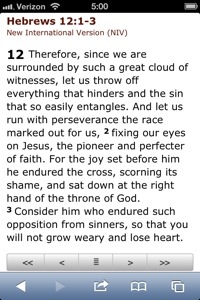
This morning I asked God to show me in His word what I needed to do to change my life, my attitude, my everything. I asked Him to show me why I’ve been having the struggles I have been, and how I can persevere. He showed me this, from Hebrews 12:1-3….

20130411-050041.jpg

It would appear I’ve got some work to do.

Face Plant

My younger son likes to run in parking lots. He sees his big brother do it—run from the car to the apartment—so he thinks he can, too. The part he doesn’t understand, of course, is that his brother is looking for oncoming cars.  He’s also a whole lot faster. In any case, we make John hold someone’s hand when we’re going from the car to the house or the house to the car.

Yesterday, we were walking from my car to the house, and  he was holding onto my little finger. David took off like a shot, and John looked up at me and said, “run, Daddy.”

I knew what he wanted, but I said “Daddy doesn’t want to run. Daddy’s tired.”

“No, John run,” he chastised me. He dropped my finger and took off—for about a second, anyway. Then he hit the big yellow speed bump in the parking lot and face planted. He started shrieking immediately, so I scooped him up and held him. I determined there were no fresh wounds, and no blood. “It’s ok,” I told him. “You’re ok, Daddy’s got you.” 

It occurred to me if I’d been holding his hand, he wouldn’t have been able to take off, and certainly wouldn’t have fallen and hurt himself.

I realized I’m like that with God.

Sometimes I feel pretty good, and I want to run. So I drop my Father’s hand, and I take off.  I may cruise along for a little while, but I will inevitably face plant when I hit a speed bump. I do this all the time. It’s so easy to think I have things figured out, and that I can do what I feel like, and just run like a madman whenever something strikes me.

It works about as well for me as it does for John running in a parking lot.

I need the stability that comes from having my Father—my God—holding my hand. When I slip (and I will slip), he catches me. Maybe I dangle for a second or two, but I am able to get back on my feet a whole lot more quickly than when I’m on my own.

One of my earliest memories is walking back from some store with my sister when I was very small.  She’s holding my hand and I look up at her when she says something. The sun comes through her hair and I squint at the brightness.  All I can think about is being with her and playing with the small bag of cheap toys we’ve just purchased. I feel the slight dampness of her palm and with it comes the awareness that her grip is strong enough that I can swing from it. I’m safe in her hands.

I want to be like that with Jesus, and sometimes I am.  When I allow myself to love him like a child loves. That is not always an easy thing. I want to feel small, and look up at my impossibly big God. The problem is when I forget I need to be held just like my son, because it’s so damn easy to slip. And we all know what happens then.

face-plant640_s640x427


On Bullies and Hope

Today, my six year-old son, John, got in a spot of trouble at school. It was nothing major, but it resulted in three days of “lunchtime detention.” What happened was that right now my son has a couple of crusty cold sore/fever blisters on his bottom lip. This kid decided he was going to make some sport of him for it. John has been taught to use his words, and ask others to stop their errant behavior in situations like that. So he asked the kid to stop making fun of him. Eventually, the kid apparently did. John, however, was still mad, so he punched the other kid in the chest anyway. My wife called me at work to tell me about it, and I could not find it in myself to be mad at him for defending himself. He has also been taught that the bible teaches us to be kind, and to turn the other cheek when things like this happen. We teach the boys they should treat others how they’d like to be treated. So now, we’re going to talk to him about the incident tonight. We’ll explain to him about appropriate behavior. We’ll tell him he should always go to the teacher first.

Also, I want to talk to him about what bullying is, and what he should do if he encounters it. I do not believe today’s incident does, but kids being the jerks they sometimes are, he may come into contact with it eventually. Or perhaps even be the bully, and I really hope that never happens. There’s been a lot said and written about bullying—both cyber and otherwise—over the past few months and years, and much of that was in regard to young people experiencing it in such a way that they ended up taking their own lives. Or expressing their frustration and pain through taking out on their tormentors, or sometimes just people who happened to be there the day they decided they could not take it anymore.

While I do not believe violence is ever the first choice in a situation, I do believe sometimes it is the only choice. If either of my boys were being physically mistreated in some way–by anyone–I would tell them to first inform someone in authority, like a parent or teacher. If the kid stops, fine and move on. If the kid does not stop, and they feel threatened or are themselves protecting a person being mistreated, I would tell them to defend themselves appropriate to the situation. I believe there are bullies who only respond to like treatment. I would rather see my sons strike another person than to be mishandled to such a degree they are seriously harmed. In other words, I believe sometimes it is appropriate to defend one’s self. I wish someone had shown me how, and when, to defend myself. My dad didn’t, and all my older brother showed me was how to be a bully myself.

Not long ago, there was a young girl who was twelve, I think, who leapt from a silo to her death over a situation with some other kids at her middle school that began over a boy two of the girls liked and escalated through a series of social media posts and text messages more or less inviting the girl to die.

There’s some legal situation now, where a teen boy was so set upon by his boss at a fast food restaurant that he ended up shooting himself in front of his family, I believe it was. Or in front of their house. Something like that.

Or how about the young Rutgers student who leapt from a bridge in New York after he was cruelly “outed” over the internet by his roommate. Also the Irish girl who was so piled on by other students in her high school here in the U.S. that she sought out a rope.

Cruel behavior amongst children is rampant these days, and it’s terrifying. They are awful to each other, for all manner of things–sometimes for no reason at all.

Fat kids are bullied (I could tell a few personal stories about that one). And skinny kids. Poor kids, or kids who wear the wrong clothes. Kids who are from the “wrong” side of town, whose house might not be as nicely made as other, more well-to-do students. Kids with birthmarks, or pockmarks, or scars. Sometimes–maybe even a lot of times–kids bully other kids out of jealousy for something the bullied kid has, or can do.

Nothing is so cruel as a teenager who for some reason thinks the only way he or she can reach the proper level of popularity is to prey on weaker kids, or kids with some imperfection or maybe just a character trait or even an accent that can be spotlighted.

I think that stuff (bullying) starts at home. By that I do not mean that a parent or sibling is the source of what’s going on, or that he or she being bullied has brought it on themselves. But home is where how they learn about why things are. We parents have the solemn duty to explain. If I thought it were productive, I could tell lots of stories to my kids about my childhood about how hard things sometimes were at home and with other kids. Except I don’t believe that would help anyone. Sure, transparency is always held in high regard, but only if it edifies, or if the boys can take something helpful away from it.

I had a cast on my left arm nearly to my shoulder for most of my freshman year. Usually, most kids left me alone, but for the first week or so after it happened, it offered me some small measure of celebrity because I was able to relate the story of the break over and over again. It made a sound like a large carrot stick snapping, and I got to where I could describe it pretty well. Soon, though, I was just another poor and overweight kid who wanted desperately to disappear into the swirl of activity that high school was.

But I remember there was this one kid in my 9th grade Geography class who sat directly behind me and thought it was great fun to kick or punch me in the small of my back. I suppose he wanted to get a response from me, but he never did. I didn’t tell on him, but I never made a sound to acknowledge the blows, either.

The teacher was this tiny old German Jewish lady—a sweet little grandma—that knew a lot about the world, and probably much of cruelty. This same guy that liked to pick on me, along with a “friend,” one day cut a small swastika from masking tape and stuck it on the lens of the classroom projector, so that when Mrs Kohls turned on the projector at the back of the class, a large swastika was displayed on the movie screen at the front.

I don’t remember what she did after that, but when I walked out of the class that morning the swastika guy accosted me just outside the door. I didn’t say anything to him, but just shoved him against the wall and walked away, directly to the counselor’s office.

I didn’t do anything to speak up for the teacher, or even for myself, really. I didn’t have any fantasies of coming back to school strapped and exacting my revenge on my tormentors. I just wanted to get away from them. So I made up some dumb reason, asked for a transfer to another class, and got it.

I was sick of hearing about how my clothes looked cheap, and how I should be going to a different school. I was sick of hearing that my hair was too long, or too shaggy, or that I was a pussy because I didn’t stick up for myself and fight, or play football (because even at that age, I was very large). Football, of all things. So what if I didn’t want to play football? Varsity and JV both stunk anyway. And in regard to not sticking up for myself, it wasn’t necessarily that I was afraid to–I’d just never learned how. I just gritted my teeth and bore it as best I could.

I often wondered what he and others got out of mistreating me and other kids that weren’t cool enough, or weren’t something enough to be offered the same respect and freedom from cruelty that the majority of the other kids received. Also worth mentioning, it was about this age that I did begin to develop a defense mechanism that would stay with me for most of my adult life–self deprecation. If I ragged on myself hard enough, there would not be anything left for them to say. I actually became pretty adept at it, and honed into a rather quick and occasionally wicked sense of humor. I felt like it helped me then, and perhaps it did, to an extent.

Except I eventually realized it made me a bully in my own way–making fun of other kids without the ability to effectively banter and talk smack. It was so easy to do, and it took the attention off me. All I had to do was give the same crap to others I had gotten for so long myself.  I should also add that one of my chief regrets as a teen is that I never did anything about that thing those two idiots did with the projector and the tape, or do anything afterward. I knew it was wrong, and I don’t know why I dragged my feet and did nothing. What I wanted most was to get away from those two kids–to find something that would make sense, because nothing else did. I never really like the school and the classes I was made to attend did, either.

What I did find was drama class, and a room full of other kids who didn’t fit in anywhere, either. It was a big, really diverse group, and more importantly to me, none of the “cool” kids were in it. I had never been so happy to be anywhere in my life.

It was that class which helped me to realize that I was not alone. There were other kids who were poor, or funny looking, or had scars. I didn’t know any gay people at the time, but I would guess there may have been one or two of them there, too.

What I did realize was that in time, things really did get better, and I never ended up on a rooftop with a rifle or thought seriously about ending my own life. I was lucky in that regard because I am well aware now of the cost of feeling that way—like you’re alone, and there is no hope at all.

There is hope.

I didn’t know Christ then, but I had a small circle of friends that through their presence in my life lifted me up above the nonsense I was going through, and the careless cruelty of other teenagers. They did it by simply being there. Sometimes with words, and other times with nothing but the quiet fellowship of other people who knew exactly what you were going through. It was enough.

Again, I was very lucky.

If anyone at all is reading this, maybe you’re like that, too. Maybe there’s someone who likes to try and make you feel like you’re nothing, and you never will be. Maybe they hurt you physically, and maybe it’s just words. Either way, the pain is all too real, and sometimes feels like it’s more than you can take.

I am fully aware how hard it is, but I promise you it will not endure forever. There is an end, and things do—really do—get better. Talk to someone. A friend, a family member. A pastor, a teacher. Just talk to someone before you take any steps you cannot come back from. You are here because God wants you to be. You matter, and are loved. God made you the way you are, and God doesn’t make mistakes.

So what I want to do today is explain to my son a little more about Jesus as the one who heals. As the one who grants patience, and balm to a pained and weary soul.

Let me say just a few more words about my experience. After I got out of that class, I never experienced any more bullying. I huddled with the other “drama geeks” and we circled our wagons to protect ourselves. It worked. We were protected, but I’d be lying if I said I never had any fantasies about facilitating some real justice against my two Geography class foes. I wanted them to hurt, and to suffer like I did. I felt like I’d be ok with that–even happy. When I think about it now, I realize that rejoicing in another’s misery–no matter how seemingly justified–is never the right thing to do. I was wrong to hope for the comeuppance of those two young men who had made my life so difficult. Sometimes I wonder what happened to them.

I wish I had a tidy epilogue to wrap things up, but all I can really say is that I am not now who I was then, though that person still lives within me. I hope anyone who reads this that’s been picked on, belittled, hurt or abused in any way just hangs on for a little while longer. And then longer still. Change takes time, for everyone. And you’re stronger than you know.

You don’t have to beat up that kid on the playground for things to get better. Letting God do the hard work helps a lot more. Yet even then, there may come a time when it is appropriate to defend yourself. It’s ok to know how to do it in practice, and in actuality. Though there are consequences for like behavior in that way–sometimes long-lasting ones. If we choose that route, we have to be ready to face them.  I can’t find it within myself to tell my kids they should never defend themselves. Sometimes they should.

All I know is my kids need to know the difference between defending themselves and others, and the behavior of a bully, who hurts because he can. Today was probably the first instance where my little guy had someone actively show him meanness at school. I’m pretty sure it won’t be the last. I hope he learns more about forgiveness than violence, and that’s on me.

With all that said, I will also teach him what merits a strong defense and what does not.

This is not exactly the right song to close with, but close enough….

On Marriage and Sanctity

Just finished reading an article about Starbucks and their vocal and financial support of gay marriage.

Something occurred to me just now: you hear people speak about this issue all the time, and those against it often mention that legalizing gay marriage threatens the sanctity of the institution itself. Does it, though?

If two men or two women were able to marry each other, would it make me any less married to Jenny? Of course not.

Would they actually be married, though?

It depends on what you believe. If you believe it’s simply the law’s recognition of the institution of marriage that legitimizes it, then making gay marriage legal is really simple.

If you believe that marriage was created and defined by God then the whole debate gets a little more complicated. For me, I do not personally feel my marriage threatened by whether or not those two fabulous guys down the street can tie the proverbial knot. I just don’t.

The problem arises, I think, when the possibility of Churches or individuals who perform (or can perform) wedding ceremonies, and who do not believe gay marriage is solely legitimized by the law are compelled by that same law to perform that which their faith and their God tells them is not legitimate at all.

I think that is a real possibility, and if it happens would be an affront to the religious freedom promised by the constitution of the United States, which was meant to protect states from favoring one religion over another.

So if we, based on law alone, attempt to force people to comply with the viewpoint of secularism over Christianity, or Islam, or Judaism (none of which recognize gay marriage), we are favoring one religion over another, because secularism taken to that level is very much like a religion. Even worse, we are denying the constitutional rights of Americans.

Here’s the other thing I was thinking about: what if what threatens the sanctity of marriage isn’t gay marriage at all?

Think about it. People cohabitate for many years and often do not marry. Society accepts that, and it is now very much the norm. Men and women also frequently approach marriage like they would contract negotiations for a house or car, and it’s no wonder there’s a 50% divorce rate. What else should we expect with such low expectations.

I think what threatens the sanctity of marriage is making marriage about law and only law, leaving sanctification out of it completely (sanctification = holiness). Soon, we will simply specify a desired term of marriage, sign a contract, and that will be that.

Marriages will fail, or never happen at all. Kids will grow up with single mothers (a single mother, by the way, is a noble thing, but they were never meant to shoulder that burden alone), and never have any idea what marriages are meant to be and can be.

I think the sanctity of marriage is also threatened when we make it a business or political interaction and not a covenant.

Should gay people be allowed to legally marry? The law will decide that soon enough, and it won’t be the death knell of the church at all. What it will be is a symptom of the decline of freedom, and the further separation of “church” from “state,” which is really sort of false.

It’s false because as I mentioned before, secularism has become very much like a “modern” religion (or anti-religion) and is being used like a cudgel to beat down those who do not agree with its precepts.

If you don’t conform to the secular status quo, then you’re a relic of a time not fondly missed. Or maybe just a “hater.”

Full Disclosure

I’m not ashamed of my faith. I’m not afraid to tell people about it, even though I know there are a great many people out there who do not believe, even in my own family. The thing is, sometimes I have often gone about it in such a way people have been put off by my words rather than inspired or moved toward God.

I know what God has done in my life. I can see it every day when I look at my wife and my kids. I think about how alone I was before, even when there were people around me. It isn’t like that anymore. I feel the presence of God in my wife’s touch, or in the voices of my children.

I remember how my heart felt prior to having Jesus within, or recognizing his sovereignty. I remember long nights and endless days trying to fill the empty places with something, with anything, with everything. I would do (and did do) anything to find fulfillment, and give meaning to my life.

I’m ashamed and embarrassed of many of the things I did. I can’t believe when I think about that God actually accepted me as I was. I broke commandments. I broke laws. I helped ruin a marriage. I used the gifts given me by God to amuse myself and others at the expense of the weak, and the least of these. I did so many things to excess, and it often felt like my heart was full of worms. I was truly a wretch, but I was able to hide it from people well enough to get by. Thankfully, though, there is this:

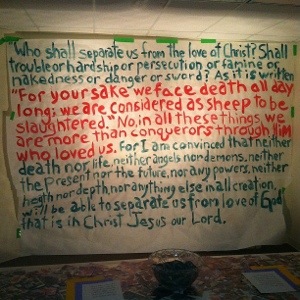
20130324-054633.jpg

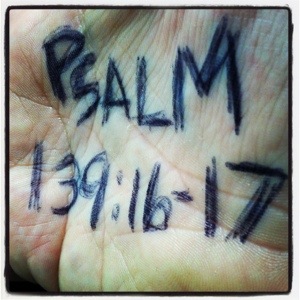
And this:

20130324-054730.jpg

your eyes have seen my unformed substance;
And in Your book were all written
The days that were ordained for me,
When as yet there was not one of them.
How precious are your
thoughts to me, O God!
How vast is the sum of them

I think where I often went wrong was not just in the communication of what I believed to be the great work done in my life, but in my tendency to shout about it. People do not always respond well to or appreciate the level of enthusiasm possessed by a person who has experienced a sea change of such a great magnitude. Especially those who do not believe.

Many of the people I know who are unbelievers respond to declarations of faith with what for me seems unjustified anger often bordering on rage. They don’t understand why people of faith always have to talk about it. It makes them uncomfortable.

Sometimes I would let the message get lost during delivery, and that’s a shame. It’s cost me a great deal of worry over the past few years that my words or actions may have caused people to turn farther away from God.

Often, people who don’t believe will tell you the things they think about Christians based on what their experiences have been. Those experiences are usually negative, and why they typically respond to people of faith with such vitriol.

Where I have often gone wrong is in marginalizing those experiences rather than validating them. People who have had painful experiences at the hands and words of Christians are hurting regardless of what I may think about their wounds.

Allowing their hurt-based responses to my often inept words to wound me in turn does nothing but draw all concerned farther away from God.

So I suppose what I need to do is find better words. Or maybe, as the song says, let my life be the proof, the proof of your love.

If it is true that people will know us by our fruit, then I need to learn to better describe my experiences. I think the key may be in looking more to these two gentleman, who have changed my life so dramatically.

20130324-061302.jpg

20130324-061318.jpg

Of Easter, Panama, and Miracles

I’ve been thinking the past few days about Easter, and something that happened back in 2010. It didn’t seem like much at the time, but when I think about it now it’s pretty amazing. God really can transcend all boundaries, including language.

I was in Colon, Panama for a month of testing, and by the middle of the month I was missing Jenny and David something terrible. She was several months pregnant with John, and I just wanted to be there for everything. Every Dr appt and every ultrasound.

I missed church, too, and had been struggling to maintain my spiritual disciplines away from my wife and pretty much all accountability. I was the only believer on the test (that I knew of), and though there were several churches nearby, we could not leave the grounds of the hotel unescorted because they told us it wasn’t safe for Americans.

I badly wanted to just be around other believers, and to feel like I could worship freely, especially with Easter coming. Well, the Saturday before Easter ended up being pretty amazing.

We got back to the hotel from Ft Sherman a little late–there had been a long wait at the canal. When we walked into the lobby (which was huge), I could see something was going on. Workers were setting up risers, and there were several people milling around in full middle eastern costume. It seemed clear there would be some sort of Easter presentation.

I went up my hotel room to shower and change out of my work clothes (I’ve never sweat as much before or since as I did in those 4 weeks), and then stood for a moment in front of my room’s mini fridge: nothing but lunch fixings and a six pack of Balboa, one of the local cervezas. My instinct was to turn on the TV, order room service, and get started on the Balboa. I decided to go back downstairs instead. I put the 6 pack in a plastic grocery bag and headed down to the lobby to look for my coworkers and maybe check out whatever was going on.

I stepped off the elevator and just stood there, slackjawed. The lobby had been transformed into what looked like first century Jerusalem, and what had to be a choir was standing on the risers.

They performed a fully sung through version of the last supper, the passion of Christ, and the celebration at his return. These may have been Panamanian church locals, but they could sing their faces off.

About 2 songs in, one of my coworkers stepped off the elevator behind me, and I handed him my sack of Balboa. He looked at me for a second and said something like “I’m gonna go eat.”

I told him I’d be there in a little bit, and he wandered off to the restaurant. After a half hour or so, the passion play ended, and everyone in the lobby watching was still standing there.

Ok, I thought. What’s next?

Just then a slender man in a black suit who looked very much like the singer Marc Anthony walked between two risers holding a microphone and began to speak in Spanish. Clearly, he was a pastor, and though his delivery was too rapid for me to translate every word, I picked up enough. Certainly, the word Jesus is universal. He also used the word milagroso several times, and I understood enough to agree with him.

It was a miracle. Easter was, and Jesus himself was the largest miracle of all. Yet also available to all. He turned to look in my direction, and his eyes were so kind. He closed his eyes and began to offer an empassioned prayer. Just as he began, I felt a gentle hand touch my shoulder. I turned to see an older Panamanian man in a nice, but slightly threadbare suit.

He said something in Spanish, and followed it up with “pray for you?” in heavily accented English.

“Ok,” I said, and while I could see the pastor doing his thing, all I could hear were the gentle words of the man behind me. They flowed around me, and I felt myself come undone, just a little. I felt the touch and the comfort of my Savior through an old man praying for me in a language I didn’t really know.

He finished up, patted me on the shoulder, and went on his way. I eventually found my way to one of the lobby chairs and spent about a half hour just thinking about things, and praying on my own.

I don’t think God arranged that passion play just for me, but I also don’t think it was an accident. For about an hour, in a hotel lobby in Colon, Panama, Jesus was represented fearlessly, and pretty accurately given the place and amount of time the cast and crew had to work.

And as I sit on my couch in Arizona this morning, I think of the old man who laid his hand on someone he didn’t know and did the only thing that could have helped: he prayed for me.

Milagroso, indeed.

No Servant is Greater

The room would do, Cephas thought. Four walls and a roof. What more did you need?

It was mostly just a functional space–a place where people gather for a meal, and then return to their homes afterward. In the middle of the room was a long, low table which could be easily moved if more room was needed. There were few decorations of any sort. Cephas and his friends reclined around the table on cushions, waiting for Jesus to speak as the meal was served.

He always spoke.

The smell of meat, fish, and bread filled the air, and Cephas began to feel his stomach growl. He wondered if the others could hear it. There were small dishes of dates here and there on the table, and several small platters of soft cheese. Cephas felt like grabbing handfuls of everything and foregoing the wooden plate in front of him—it wouldn’t have been the first time.

The Lord sat at the table’s center, and after a brief glance at them, He stood without a word and walked to a large, beaten metal bowl that sat by the door next to a small wooden milking stool. On the seat was a folded linen towel. Next to it was a clay jug full of water. Cephas wondered what He was doing. But then again, He had been known to go off on his own at times. Maybe He was leaving.

He didn’t leave.

Jesus removed his outer garments, setting them gently on the floor next to the stool. He picked up the towel and wrapped it around his waist. Cephas noticed once again the effect that decades of working with tools and his hands had on His body. He was slender, but strong, and his hands were large. They were callused from his work, but surprisingly gentle as he took the clay jug and poured water into the bowl. He picked up a wooden ladle from the ground next to the bowl, and without another word, he walked over to the man closest to the door, knelt down, and began to wash his feet.

This was the task of a servant, Cephas thought–a lowly servant at that–and he couldn’t believe the Lord was doing what He was doing.

It wasn’t right. He felt his temper begin to flare, and he began to stand.

And then the Lord knelt at his feet, setting the bowl and ladle down next to him.

“Lord,” Cephas asked him, “are you going to wash my feet?”

Jesus looked up at Cephas, and his eyes were brown, and kind, and full of love. “You don’t realize now what I’m doing,” he replied. “But later you will understand.”

Cephas began to feel angry again. Why was He doing this? And what won’t he understand now? He understood that Jesus should not be performing the act of the lowliest of servants—he understood that much.

“No!” he said, and it was almost a shout. “You will never wash my feet!”

Jesus looked at him for a long moment and then answered in a soft voice, “Unless I wash you, you will have no part with me.”

This made no sense. “Then, Lord,” Cephas said, “not just my feet, but my hands and my head as well.”

Jesus answered, looking into his eyes all the while “A person who has had a bath needs only to wash his feet; his whole body is clean. And you are clean, though not every one of you.”

This last statement made even less sense. Who was the Lord talking about?

Before he could ask, Cephas felt the hands of the carpenter on his feet, removing his sandals. Jesus put them aside, then set the bowl beneath Cephas’s feet. He scooped water up with the wooden ladle and slowly poured it over his ankles, then his feet and toes. He gently rubbed the dirty feet, and then poured more water over them to rinse. His hands were strong, but gentle, and Cephas could see the dirt and dust slipping away, falling back into the water. Then he slowly dried his feet with the rough towel, and Cephas felt nearly overwhelmed with emotion. This act, this simple act of a servant humbled him—nearly crushed him—and suddenly his appetite was gone.

Jesus moved on to the next man. When he was finished washing all their feet, he once again put on his rough clothes and returned to his place at the center of the table.

“Do you understand what I have done for you?” he asked them. “You call me ‘Teacher’ and ‘Lord,’ and rightly so, for that is what I am. Now that I, your Lord and Teacher, have washed your feet, you also should wash one another’s feet.”

He stopped for a moment and looked at them all. Then He looked directly at Cephas.

“I have set you an example that you should do as I have done for you. I tell you the truth, no servant is greater than his master, nor is a messenger greater than the one who sent him. Now that you know these things, you will be blessed if you do them.”

His voice was soft, but Cephas felt as if he could have heard it from outside the Sheep Gate. He rose a little from his reclined position and looked at his feet. He thought about what Jesus had done, and bade him to do.

He wondered if he could do it.

Jesus continued. “I am not referring to all of you; I know those I have chosen. But this is to fulfill this passage of scripture: ‘he who shared my bread has turned against me.’”

What was Jesus talking about? They’d all shared his bread, hadn’t they? Who among them could turn against him?

“I am telling you now before it happens, so that when it does happen you will believe that I am who I am.” He looked briefly at all of them. “Truly I tell you, whoever accepts anyone I send accepts me; and whoever accepts me accepts he who sent me.”

Jesus looked troubled after he said this last, and sat quietly for a moment before continuing. “One of you is going to betray me.”

Cephas looked at the other disciples, and they at him. Who could he mean? John reclined against the Lord, and Cephas motioned to him and said quietly into his ear, “ask him who he’s talking about?”

John leaned back against Jesus again and asked, “Lord, who is it?”

“It is the one to whom I give this piece of bread when I have dipped it in the dish,” he said, and dipped the corner of a small piece of warm bread into a small bowl of dark and steaming broth. Then he handed it to Judas, son of Simon.

Cephas saw Judas take the break and hold the gaze of Jesus for a moment. His head slightly rocked back and he looked into the eyes of the Lord. He did not speak.

“What you are about to do, do it quickly.” He let go of the hand of Judas, and it fell downward like a piece of fish. Judas looked down at it. Everyone else looked at him, trying to understand why Jesus said what he did to his disciple, and friend.

Judas controlled the coin of the group, and some of the disciples whispered that he could be talking about purchasing the items needed for the upcoming Passover festival, or maybe simply giving some or all of the money to the poor, who seemed to gather everywhere they went. Whatever the reason, Judas took the bread from Jesus, rose from the table, and quietly went into the night.

Cephas noticed everyone fell silent and stopped eating. What had just happened? Jesus sat quietly for a moment and then spoke quietly.

“Now the Son of Man is glorified and God is glorified in him. If God is glorified in him, God will glorify the son in himself, and will glorify him at once.”

Not for the first time, Cephas wished the Lord would just speak plainly.

“My children,” Jesus continued, “I will only be with you a little while longer. You will look for me, just as I told the Jews, so I tell you now: Where I am going, you cannot come. A new command I give you: love one another. As I have loved you, love one another. By this, everyone will know you are my disciples, if you simply love one another.”

Jesus paused, and looked about to weep. “Lord, where are you going?” Cephas asked.

“Where I am going, you cannot follow now, but you will follow later.”

Cephas leaned forward intently and asked, “Why can’t I follow you now? I would die for you.”

“Will you really die for me? Listen to me. Before the rooster crows, you will deny me three times.”

Never, thought Cephas. I would never deny him. He looked at the walls, the table, the other disciples, anywhere but at Jesus. He was at a loss. The Lord thought him a traitor. A betrayer. Had he not also said the same of Judas just moments before?

Jesus smiled at him and started speaking again. He was talking to all of them, but Cephas felt the words sink into his heart and it was if the Lord whispered in his ear.

“Do not let your hearts be troubled,” he said. “You believe in God; believe also in me. My father’s house has room for all. If that were not so, would I have told you I am going there to prepare a place for you? And if I go there to prepare a place for you, be assured I will come back and take you to be there with me, near to where I am? You know the way to the place I’m going.”

They all likely thought the same words, but it was Thomas who spoke. “Lord, we have no idea where you’re going. How are we supposed to know the way?”

Jesus answered, “I am the way. I am the truth and the life. Only through me can you come to the father. If you really know me, you will know my father as well. From here on, you do know him, and have seen him.”

Philip said “Lord, just show us the father and that will be enough.”

Jesus answered, chastising him gently. “Don’t you know me, Philip? I have been with you for many months, and many hardships. Anyone who has seen me has seen the father. So how can you ask me to show you the father? Don’t you believe that I am the father, and that the father is in me? My words are not spoken in my own authority. No, it is the father—living in me—who’s doing his work. Believe me when I say that I am the father, and the father is in me. Or at least believe because of the work itself. Whoever believes in me will do the works I have been doing all along, and they will do even greater works than these, because I am going to the Father. I will do whatever you ask in my name, so that the father will be glorified in the Son. You may ask for anything in my name, and I will do it.”

The room was silent, and everyone looked down, thinking. Cephas thought about doing the kind of works he’d seen the Lord do on many occasions, and it did not seem possible.

Could he heal? Could he give life? And how about teach? He was a fisherman.

Anything, Lord?

Needy Bastard

I figured out something about myself a little while ago, and like many important things it came to me out of the blue—well, sort of. I’ll try and offer a little peek at how my mind has a tendency to bounce around and make connections really quickly. Often, the conclusion will make sense to me, but will confuse others because my thought process works a little bit like a short circuiting transformer—sparks will fly everywhere.

What happened was that I caught myself humming the refrain of a song I’d heard a while back. I’d seen a video clip from the X Factor UK of a young English man singing an acoustic version of a hideous Brit-pop song called “Young” by a singer called Tulisa, who also happened to be one of the four judges. The chorus went something like:

Forgive us for what we have done

We’re young, we’re young, we’re young

I was humming that as I walked back to my truck from an errand, and then I looked up the clip on YouTube on my phone. The singer was a young guy named James Arthur, and his audition was really good. I watched the clip again and during the backstory part, Arthur explained how he’d been on his own since he was a teen and his parents split up. He didn’t want to be around their fighting and such. So he put himself into foster care. He got into a lot of trouble, which is perfectly understandable, given his circumstances.

Watching that clip for some reason made me think of a Sunday School class I’d taken at FCC a while back taught by Rod Reed. It was called The Quest for Authentic Manhood, I think, and was based on a book by Robert Lewis. Lewis had a pretty rough childhood and grew up—like James Arthur—largely without the influence of his father, at least for a time.

One of the things Lewis says in the class is that there are a few things every boy needs to hear from his father:
I love you

I’m proud of you

You’re good at something (whatever that something is)

What I thought of today was…that’s why I’m so needing validation and approval, even though I understand intellectually that I’m a grown man with a wife and a family and a job and I’m doing pretty much OK.

My dad died when he was too young, and I was younger, and I never really heard any of that stuff from him, at least not that I can remember. I don’t think I heard it from anyone for most of my life, actually. Well, not the last two, at least. I knew my sisters loved me (and my friends, in their own way).

I messed up a lot when I was younger, and it didn’t really seem to make any difference, so I continued to mess up. Today I realized there is something to Lewis’s words.
He was right—I needed to hear those things. I still do. I think that’s why my sometimes strained relationship with my sisters and other family in San Diego bothers me so much. They don’t even come close to understanding my faith, and the huge work that God wrought in my life. They are vehement atheists who give every indication of despising what I believe has become the great work and passion of my life—telling people about what Jesus has done in it and can do in theirs, too. They basically want me to not be so vocal about it, and that is something I struggle with.

My sisters love me, and love my family, but think the change in my life was not for the better. I would say they hate God, but they don’t believe, so that’s not exactly the right way to say it, but you get the point.

I am happy here in Arizona, and I love my life, my family and friends here, and my church. I am thankful for everything that God has brought to my life. Every day I think about how different my heart is now, and how I feel on the inside.

I would love it if my SD family could see that, too, but I have to admit to myself it is unlikely that will ever happen. I would love it if they would come here and see the life my wife and I have made for our family, and that we’re happy and not at all the deluded religious zealots they probably think us—me, at the least.

I want them to be proud of me. I want them to be part of my life. But I also have to realize those things are probably not going to happen, either. They will likely never come here. So that particular desire will probably continue to go unfulfilled, at least for now.

The other thing that occurred to me was that it did not matter at all what anyone else thought—those closest to me and my life understand what God has done in it. Writing things like this will hopefully make others on the outside understand as well. I want to also note that any relational gaps between myself and my sisters are probably almost entirely my fault. I screwed up pretty badly with them when I was younger, and am reaping the fruits I sowed then now as an adult. I can’t blame them for not being closer.

So what I learned about myself today is that my need for approval and validation can sometimes cause me a little emotional difficulty (and probably some awkwardness for others as well). For now, I can rest in the knowledge that I have the unconditional love and support of my wife and my family, even my family in SD (they may not share my…spiritual conviction, but they do love me as best they can given the circumstance of our long distance). I don’t need to continuously seek approval from anyone but God. And I need to accept my family’s belief (or lack of belief) just as I want them to respect mine. It is not fair for me to expect them to behave toward me as I want them to. They should, in all fairness, just behave simply as they are.

In short, I need to get better at loving unconditionally as well. I need to trust God to meet my needs and fulfill me—not the people in my life.

So that’s a peek at my scattered thought process. Thanks, James Arthur.

Some Thoughts on Easter

For most Christians, Easter is like the Super Bowl. Not to minimize the importance of Christmas; Christ had to be born before he could be crucified. Most people agree Jesus was born, and lived and taught during the first century around Judea and surrounding areas. There is ample evidence available to support the existence of Jesus.

Where people veer off is when you start talking about the Crucifixion and subsequent resurrection of Christ. There is a huge segment of society who emphatically denies it ever happened, and that Jesus is little more than a benevolent bedtime story.

Then you have one of the world’s most practiced religions (Islam), which agrees Jesus lived and taught, but was in the end little more than a skilled teacher and (according to some) prophet. Here’s a great video that breaks it down:

40 Arabic Words

I am not here today to refute Islam, but it is true that without the resurrection, Christmas is little more than the noteworthy birth of a talented first century Rabbi who was really good with people.

I am also not here to “prove” the resurrection true (read Lee Strobel’s The Case for Easter if you want to do that). I just want to tell you what Easter means to me.

I believe in the death and resurrection of Christ because it is by that I am healed, and live and move and have my being. I can’t tell you anything now that will prove that to you if you don’t already believe.

I can just tell you that Easter changed my life, and has made everything that happened to my life over the past 13 years possible.

Easter took a tired, broken, depressed and addicted man who didn’t care about anything (including his life) and gave him a reason to live and a means to live by.

I guess the best way to explain it is that God took the torn fabric of my life and began stitching it up, along with the otherwise mortal wounds to my heart.

He’s the only reason I am alive today, and whether or not you believe me does not change the truth of that in my heart, bound by the gentle and strong hands of a carpenter.

Easter is important to me because it reminds me of why I’m here.