Read It as Your Testimony

I did a scripture reading this past Sunday at church. It was fun–I like to do that sort of thing whenever I get the chance. I was talking to the worship leader a little bit after me and another gentleman practiced our reading, and he told me about this exercise he’d done in a grad school class that I’m still thinking about.

What they did was read scripture, and then the intructor had them read it again, except this time they read it as their testimony.

Darrin told me there were more than a few people tearing up, and I can see why. There’s nothing that makes people feel more than hearing someone like them talk about an experience they may have gone through themselves.

What I’ve been thinking about since that discussion is, what scripture would I read as my testimony?

It actually didn’t take a lot of thought–I’ve always seen more than a little of myself in the Parable of the Lost Son, as told in Luke 15. I’ve written about it several times (this being the third), and I think that nearly ever time I read it, God shows me something new about myself.

The Lost Son is so much like I was–like I am sometimes still. He wants what he feels he’s due, and he wants it now.

And his father, being full of grace, gives him what he wants. He loves him. And the son takes his inheritance and squanders it, pretty much drinking and whoring until it’s gone. Not that I ever went whoring, but I did waste my inheritance for a very long time.

What happened was that–like the son–I hit the bottom like the Titanic. And the only place I could go was back to the Father. Same as the Son in the parable, who returned in spite of himself. Who didn’t want to return, but realized that was the only option left. That, or death.

So the son returns to the father, and the father welcomes him. My NIV depicts the Lost Son’s turnabout like this:

17“When he came to his senses, he said, ‘How many of my father’s hired men have food to spare, and here I am starving to death! 18I will set out and go back to my father and say to him: Father, I have sinned against heaven and against you. 19I am no longer worthy to be called your son; make me like one of your hired men.’ 20So he got up and went to his father.

”But while he was still a long way off, his father saw him and was filled with compassion for him; he ran to his son, threw his arms around him and kissed him…”

I guess these words are something I need to be reminded of, so I can remind others. So I can make sure my kids know it as well.

And make no mistake, there are still times when I feel like the Lost Son. There are times when I feel I need to throw myself at my father’s feet and beg forgiveness. Lately, lots of times.

Recently, again, I’ve felt like I’ve been wasting away my inheritance. Wasting it with my feeble prayer life and inconsistent discipleship. Wasting it with my poor example to David of what a Christ-following man looks like. Wasting it by not being the strong leader my family needs me to be, especially with John here, growing so fast, and the challenges that presents.

And now, I’m ready to come back to my Father. Amazing how God just brings things to the surface of your heart sometimes, like the impurities brought forth during the refining process for precious metals.

The metal is heated, so the impurities come to the surface. Why? So they can be removed, by the refiner. And it’s important to remember the refining process is not done just once. It takes a long time.

It takes a lifetime, and we don’t get to shine like new gold until we get to Heaven, and sit at the feet of the Father.

And so today, I turn to my old friend Luke. I had to read the scripture again this morning, courtesy of the wonderful and readily available Bible Online.

And then I read it again. But maybe it isn’t just me.

Who among those who believe has not done the same? Who hasn’t been the lost son? Who hasn’t taken generosity and love for granted? Who hasn’t, in a sense, demanded their inheritance early? I think of all the times I’ve responded to God in a like manner. Maybe that’s the point, though. At least for me.

Personal conviction. And awareness that I need to repent anew.

Something always strikes me about the Lost Son parable (AKA the parable of he prodigal). Not so much the son’s apparent repentance–to me that smacked of forced contrition, not true remorse. He’s broke, and hungry, and has nowhere else to go. He’s just relating what he’s going to do, not baring his heart, or even seeking forgiveness. He came to his senses, it says, but that’s all. The son could have just been talking about finding a meal at that point.

He’d wasted away his inheritance. There was a famine. Why not return to the source of the inheritance, where the servants fared better than he was at the time?

Certainly, all those things are important. Yet what impacted me most was the father.

His grace toward the son.

The passage mentions that he sees his son when he was still a long way off, so he had to be outside looking for him. Scanning the horizon. Desperate to see his son return. I can see him standing there, shading his eyes with a hand.

Looking.

Waiting.

Hoping.

Not seeing.

Yet every day, looking.

It does not say how long he looked for his son. Only that:

”But while he was still a long way off, his father saw him and was filled with compassion for him; he ran to his son, threw his arms around him and kissed him…”

It kind of makes you think about the shepherd looking for his ONE lost sheep, rather than writing it off because he still has 99. He will pursue the lost one, and he will be filled with Joy when he makes it back home with that one sheep across his shoulders.

That’s the same Joy God feels when we return to the fold.

How he felt when, like the prodigal, I came to my senses. When I stood, looking across the Colorado river with tears running down my face and holes in the knees of my jeans. Was it forced contrition with me? Perhaps in a sense it was. But God did not care how I came back to him—just that I returned.

He felt joy. And scripture also tells us that angels rejoice when a sinner turns from his life of sin.

But look again at the father’s reaction upon seeing his son.

“his father saw him and was filled with compassion for him; he ran to his son, threw his arms around him and kissed him…”

He did not stand waiting with his arms crossed, brow furrowed with displeasure. He did not grudgingly accept a tentative and awkward apology.

He was filled with compassion for his son, and he ran to him.

He ran.

He ran, probably forgoing all semblance of dignity.

He ran, robes flying, probably with arms extended. Running across the field to his lost son.

He ran, and he was filled with compassion.

He ran, and when he got to him at last, he threw his arms around him, and kissed him.

No condemnation, no judgement.

Just love.

He threw him a party, and killed the fatted calf.

Today, I read that passage again and I thought about Jesus scanning the horizon for me, desperate to see me. I thought of him running toward me with his arms outstretched, running across a field to get to me. He’d been waiting for me all the time I’d been holding out, waiting for me to come to him. Waiting for me to come burdened, and afraid, and encumbered by the world and the lies I’d come to believe about both God and myself.

He waited for me, even though I was not ready. Me, in my dirty robes.

He waited for me with his shepherd’s arms outstretched. He waited for me, in my unclean and starving state—impure in both thought and action.

Me, covered in the filth of my journey home.

Me.

And when he saw me, he could wait no longer.

He ran. And when he finally reached me, he threw his arms around me
and kissed me.

And there was rejoicing in heaven.

Open Letter

Representative Grijalva:

Let me just go on the record as saying I hate blanket statements. Inevitably, they’re made out of anger, or some feeling of injustice. And they are inevitably almost always flawed, prejudiced, or just plain wrong.
Like the following statement made by you, Representative Raul Grijalva, regarding votes against you in the recent election:

“I’ve never had the privilege of getting a majority there, and I probably won’t have that in the future. You bring projects in, clinics, a new port of entry, and it doesn’t seem to have an effect. But the politics are more polarized and more racial in Pima and Santa Cruz, so you deal with what you get.”

Indeed, Representative Grijalva. Deal with it.

Yes, the politics probably are more polarized here. But to me, that’s to be expected. Look at the economy here, and the proximity to the border. Look at the major industry—farming, and developmental testing of equipment, weapons, and vehicles for the military. People here depend on these things for their ways of life. We need industry, and customers to come here.

Not boycotts.

Do not forget, sir, that you represent the people of this state—even the ones that do not agree with you and the way you vote on issues that are important to them. So when a senate bill is proposed (that provides the means to enforce Federal legislation ALREADY IN PLACE) to attempt to slow down illegal immigration, and approved with a significant majority, and you encourage a boycott of your OWN STATE in regard to service and industry, I think Yumans found it decidedly off-putting.

And when it came time for re-election, and you, Representative Grijalva, saw you weren’t going to get the votes here you’d get in your other counties, you made your blanket statement. Which to me, sounds like if people in Yuma didn’t vote for you, it’s because of racial motivations of one sort or another.

That may be true of some people, maybe even many people.

But it is not true of everyone.

My wife’s aunt is a staunch defender of Representative Grijalva, and maintains that Representative Grijalva should not be held accountable for encouraging a boycott because the statement was made out of anger, regarding “crap” legislation.

I don’t care why he said it, only that he did, and he meant it. That’s not in dispute. And in my opinion, that’s why a lot of people did not vote for him that might have otherwise.

But not me, Representative Grijalva. Not me.

I didn’t vote for you because you either voted for something I find morally reprehensible, or voted against something that I support.

It’s my right to NOT vote for you if I disagree with something you stand for, or voted for. So when I don’t vote for you, you have no right to imply anything about my motivations. But since you did, allow me to express why I did not vote for you, and will not vote for you next election, either.

You:

Voted NO on allowing Courts to decide on “God” in Pledge of Allegiance. (Jul 2006)
Voted YES on expanding research to more embryonic stem cell lines. (Jan 2007)
Voted YES on allowing human embryonic stem cell research. (May 2005)
Voted NO on restricting interstate transport of minors to get abortions. (Apr 2005)
Voted NO on making it a crime to harm a fetus during another crime. (Feb 2004)
Voted NO on banning partial-birth abortion except to save mother’s life. (Oct 2003)
Voted NO on Constitutionally defining marriage as one-man-one-woman. (Jul 2006)
Voted NO on Constitutional Amendment banning same-sex marriage. (Sep 2004)
Voted NO on constitutional amendment prohibiting flag desecration. (Jun 2003)

If you keep sailing along on your present course, sir, securing another victory may not be so easy next time. You may represent the people of this county, Representative. But based on your votes, you do not represent me.

Like the disciples…

We were driving home from church Saturday night, and Jenny and I were trying to explain to David what “Big Church” was about that night—it had been about prayer for the “Persecuted Church,” and less a sermon than a prayer meeting, with the prayers guided by Paul and several of the church elders. It was pretty cool.

We explained to David that there were places in the world where it was dangerous to believe, because the people there did not like Christians, in some cases to the point of imprisoning them for their beliefs, in some cases killing them for their faith in Jesus. We told him how our church has missionaries in some of those places.

He didn’t know what a missionary was, and when we tried to explain it to him, he asked if they were “like the disciples.”

We thought about it for a minute, and while that wasn’t exactly what we were getting at, the kid did have a point. It seems to me the disciples were the very first missionaries, the first people sent out to show the world the love of Jesus.

And with the exception of John (the beloved), they paid the price for their unflinching faith.

I remember hearing my pastor in San Diego talk about that very thing on more than one occasion. He explained that except for John, they were all martyred.

Though it’s difficult to determine exactly the events of their lives (and deaths) which are not depicted in Scripture, there is a wealth of information available. A brief look on the web turned up the following details:

“The Deaths of the Apostles

Matthew suffered martyrdom in Ethopia, killed by a sword wound.

Mark died in Alexandria, Egypt, dragged by horses through the streets until he was dead.

Luke was hanged in Greece as a result of his tremendous preaching to the lost.

John was boiled in a huge basin of boiling oil during a wave of persecution in Rome. However, he was miraculously delivered from death. John was then sentenced to the mines on the prison island of Patmos where he wrote his prophetic Book of Revelation. The Apostle John was later freed and returned to serve as a bishop in modern Turkey. He died an old man, the only Apostle to die peacefully.

Peter,was crucified upside down on an x-shaped cross, according to Church tradition, because he told his tormentors that he felt unworthy to die the same way that Jesus Christ had died (mention is also made of Peter’s wife suffering the same fate).

James the Just, the leader of the Church in Jerusalem and brother of Jesus, was thrown down more than a hundred feet from the southeast pinnacle of the Temple when he refused to deny his faith in Christ. When they discovered that he survived the fall, his enemies beat James to death with a fuller’s club. This was the same pinnacle where Satan had taken Jesus during the Temptation.

James the Greater, a son of Zebedee, was a fisherman by trade when Jesus called him to a lifetime of ministry. As a strong leader of the Church, James was ultimately beheaded at Jerusalem. The Roman soldier who guarded James watched amazed as James defended his faith at his trial. Later, the officer walked beside James to the place of execution. Overcome by conviction, he declared his new faith to the judge and knelt beside James to accept beheading as a Christian.

Bartholomew, also known as Nathanael, was a missionary to Asia. He witnessed about our Lord in present day Turkey. He was whipped to death for his preaching in Armenia.

Thomas was speared and died on one of his missionary trips to establish the Church in India.

Jude, another brother of Jesus, was killed with arrows after refusing to deny his faith in Christ.

Matthias, the Apostle chosen to replace the traitor Judas Iscariot, was stoned and beheaded.

Barnabas, one of the group of seventy disciples, was stoned to death at Salonica.

Paul was tortured and then beheaded by the evil Emperor Nero at Rome in A.D. 67. Paul endured a lengthy imprisonment which allowed him to write his many epistles to the Churches he had formed throughout the Roman Empire. These letters, which taught many of the foundational doctrines of Christianity, from a large portion of the New Testament.”

It got me wondering. How far would I go to defend my faith? Would I take a sword to the belly rather than deny Jesus? Would I allow myself to be dragged along behind horses until I was battered and scraped to death? Would I suffer any of those fates for my faith?

The answer, of course, is “I don’t know.” Because I don’t. I’d like to say I would, but the truth is, there’s no way to tell unless something like that actually happens to me. I think of people like Cassie Bernall, hiding out in the library at Columbine, and when confronted by the killers, answered “Yes” to the killers when they asked if she believed in God. They shot her in the face at point blank range.

People say they probably would have killed her anyway, and that may even be true. But she didn’t know that.

My old pastor at Calvary Baptist once told me words to the effect that he hoped for the chance to be a martyr someday. So he would go on mission trips to places that gave him the best chance for that to happen. That seemed like some kind of crazy at the time, but now I wonder. Is it a bad thing to want the chance to pay the ultimate price for your faith?

Jesus did it for us.

No answers today, but the little gears in my head are turning. Just coming off a very long weekend with not a lot of sleep, so profound thinking is not something I’m capable of at the moment.

Just take a moment to think about what your faith means to you, and what you would do for Jesus.

How far would you go?

Identity Crisis

There’s a scene in the movie “The Breakfast Club” where the character Brian, played by Anthony Michael Hall, is trying to begin writing the paper assigned by the study hall “teacher.” He’s thinking, and talking to himself a little, and ultimately ends up sticking his pencil eraser up his nose while asking himself “who are you?”

Who are you?

I think this question is at the root of a great many problems. People talk all the time about having identity crises, and I think they’re absolutely right—it can be a crisis. It’s a little hard to lead your life—any life—if you don’t know who you are.

And here’s another question. What if you can’t be the person you think you are? What if something is holding you back, whether it be work, or inhibition, or simply life in all its complicated madness?

What then?

How can a person really answer that question? You can give your name, but are the two or three words on your driver’s license who you really are? Aren’t they just words?

Who are we, then? And who do we think we are?

I think much of our self-identification stems from our natural affinities, our giftings, or our jobs. I’m a carpenter, or a cook, or a plumber, or a writer, or a singer. And I think one of the most commonly asked questions in social situations where people don’t know each other well is “What do you do?” in reference to a person’s job.

Is that how we’re defined? By how we make money? Where we spend 8+ hours of our time every day?

I’m a fry cook. Or a lawyer. Or a concierge. Or a pastor. Or stay-at-home mom. Or brother, sister, husband, or wife.

How can that be all there is?

Is that who I am? My name is Tom, and I’m an Engineering Technician EG2B, brother four times, and husband of Jennifer, father of David and John.

Something is lost here.

Who am I?

What is my primary identity? Do I even have one?

Is it any of those things I just mentioned? If it is, I think we’re missing a very big step.

I know that when I was at my absolute worst, before I knew Jesus, it would be a very fair statement to say I had no idea at all who I was. I went through several jobs trying to find one that suited me. I had several relationships where I barely scratched the surface of who the people were I was involved with, and I learned to medicate myself heavily with both food and alcohol because it made it so I didn’t have to think about who I was, or who I wasn’t.

But after the night I met Jesus, things became new, and different, and a little strange. I thought about Him (or tried to) before I did most things, or made big decisions.

Why?

Because, when I invited Him to be the Lord of my life, I became new. Born again, as they say.
I was a son, His son. Child of a father that loved me above all else. Child of a father that died a horrible death, for me.

My identity became Him.

I, Tom, the Engineering Technician EG2B, am a child of God.

That’s my identity, that’s who I am. That’s who I became when Jesus entered my life and my heart.
I think about that now, and it makes a lot of my past transgressions clearer, or at least what I felt to be the reasons behind them. It’s a lot easier to sin when you have no center, no compass. When all you have to define your reason for being is a vague sense of moral relativism.

And lately, the struggle has been one of time. I know who I am, and I think I know who I’m supposed to be.

But there’s no time.

There’s work, and church, and kids, and not much time for anything else. Right? Life gets so busy.

And even now, when I sin (which happens all too frequently), the reason for it is that for the moment, I’ve forgotten who I am, and who my father is. My father on earth is Melvin L Wilkins. But my father in an eternal sense is Jesus, and none other.

But sometimes I still forget. The difference now, though, is that I’m aware of the opportunity to repent. To turn away from my sin and toward Jesus. I just have to make time to do it. I have to dig deeply into the time I do have, and I have to set my priorities.

If I want to be the example to my kids and my wife I know I should be, I have to take care of some things before I can take care of them. I need to put on my armor every day. And study, and pray, and seek wisdom.

Only then can I be the father, and husband, and friend that God has in mind for me to be.

Because like it or not, my kids will look to me to see who they should be. And I don’t want them to see simply Tom.

I was born in San Diego, but in a very real sense, I was also born on a dock over a small, very calm tributary of the Colorado River. Or reborn, I suppose.

That’s actually at the root of one of my most profound experiences during my time with CVCF Healing Prayer, which I have never mentioned to anyone save the three others who were there, not even my wife until now.

I remember struggling to hear from Jesus during my prayer session, and finally, literally, asking Jesus if it would have been better had I not even been born. I was, after all, an accident. After that, I closed my eyes and fell on my face, weeping.

And what I saw was the river where I’d met Jesus that first time. I saw the man that had been myself kneeling, crying in the same way I was crying during the prayer session.

Then I felt a comforting hand on the back of my neck. A strong hand—the hand of a carpenter. And heard a voice speak into my heart “this is where you were born. And I meant you to be here.”

So here I am today.

Who am I? My name is Tom, and I am a child of my Abba.

That’s my primary identity. Before husband, or father, or brother, or anything else.

And I submit that if you’re a follower of Jesus and you don’t yet know what your primary identity is, you will never reach the fulfillment in Christ that can be reached once you do.

So ask yourself once more, who am I? And if you feel lost, or set apart from who you feel you are supposed to be, what will you do to find that person again?

This law is raising some interesting questions

I’ve spent a fair amount of time lately reading lots of outcries from people regarding our new AZ immigration law. I can understand that people don’t want to be “profiled,” but I’m wondering what the answer to the immigration problem is if this law isn’t?

Could law enforcement use the law as the catalyst for racial profiling? Of course they could. But I think it’s also true people can be racially profiled without it. People of all colors. White people, too, if they look a certain way, or maybe drive a certain type of car in a certain type of neighborhood (though I suppose that would be more “societal” profiling).

I heard a latino gentleman on the radio yesterday (he was from Mexico) talking to the host of the show (I forget his name), who asked him what was the policy regarding illegal immigration in Mexico. The caller said “zero tolerance,” and if someone is caught illegally, they’re immediately sent home.
I think what could potentially cause problems with this law is that it leaves things up to individuals. And people are people. Are there racist or poorly trained law enforcement officers in Arizona who may choose to…use this law in a way other than it was intended? Could be.

But I think it’s unfair of people to assume that every cop in Arizona is going to start pulling people over for being brown. I also think, though, there will have to be some serious, serious training involved, from the bottom to top. This is a tough new law, and it has the potential to either work, or crash and burn epically. I’m hoping the former. But I guess we’ll see.

And while I understand that people might be afraid they’re going to start becoming targets for law enforcement because they’re brown, or yellow, or pink, and law enforcement assumes they’re illegal, I think these same people should also not make the assumption that Arizona law enforcement will automatically be cruising for people to arrest. I don’t think it’s fair to assume that all cops are bad because some of them COULD be, given the opportunity. Do we not trust the police anymore because a law was signed by the governor?

Make no mistake, this is groundbreaking legislation. And it’s up to all of us how it works.

And like I mentioned earlier, if not this legislation, then what? What are we to do about borders, and about immigration? I’m from San Diego, and we have a wall there that doesn’t work very well. People laugh at it, and rightly so.

What’s the answer? Tougher laws? Easier laws? No laws? I don’t know.

Bring us your tired, your poor, your huddled masses yearning to breathe free.

I submit that it’s possible to do that without coming across the border in a boat in the dead of night, or swimming across a river, or cramming into the back of a van with lots of other people.

I work as a DoD contractor, and I meet a lot of interesting people. I was on a test once where I met a soldier from Poland, who was now a combat engineer for the United States Army. He’d done two tours in Iraq, and was now training for a third tour—this time in Afghanistan. He was going to take an energetic young black lab named Bear to go sniff out mines and IEDs. Anyway, this young man had come to the states to attend college, and had liked it so much he stayed illegally after he was done with college. But he fell in love with the country, and wanted to serve, so he eventually went home to Poland, and did what he had to so he could come here legally. And he joined the Army, where today he is probably in the mountains of Afghanistan, protecting my way of life.

Anyway, I don’t like that we have this type of legislation—that it’s necessary to secure our borders, if indeed they can be secured.

But what’s the alternative? No borders at all?

We don’t live in the type of world where we can hold hands across our borders and sing happy songs, congratulating each other on what great and tolerant people we are.

So what do we do?

Revolution Project

This weekend Jenny and her parents and I are doing a chapel service at Crossroads Mission–as a smaller part of a larger outreach that FCC is doing. Jenny, Ken and Linda will be doing a few worship songs, and I’ll be doing a little bit of speaking. We’ll have volunteers serving at the mission all day, from morning to night. Cleaning, serving food, serving people. Also, we’ll be having a BBQ/picnic thing at Ranchsomething Elementary school, and serving the surrounding community a free lunch, with some fun things for the kids to do as well. Lastly, we’ll be doing some work for Amberly’s place, which is a battered and abused women’s shelter. Below is a narrative representation of what I’ll be speaking about. Pray it goes well!

I realized something when I was getting prepared for this. It was ten years ago this month that I began my relationship with Jesus, after a lifetime of struggling and wrestling with doubt, and despair, and addiction to all sorts of things. It wasn’t something I had in mind, but God knew better than I what the perfect timing was, and that’s when things started—March of 2000. I was on a trip to Padres spring training in Peoria, and what happened was that, as CS Lewis says, “I gave in and admitted that God was God.” And I asked Him to come to my rescue, because He was the only one that could.

First, a little about me.

I’m from San Diego, my name is Tom, and I’m an addict (hi, Tom!). I wasn’t born that way—it seems to me that addicts come in pieces, and it takes a lifetime to put them together—like one of those horrible pieces of furniture from IKEA. I had a great deal of trauma in my childhood, from abuse, to neglect, to a two year period where three people close to me died in quick succession. My addictions began as comfort, and morphed into self-medication. And as with most people with addictive personalities, if it wasn’t one thing, it most definitely was another. By the time I was an adult, I would do almost anything to meet my needs, or what I thought my needs were at the time.

My addictions were many. Early on, I became addicted to food, and I obviously am still fighting that battle today. And for a while—both before the internet and after—I developed a problem with lust, and pornography. The former led me to the latter, and the latter ended up giving me a completely distorted outlook on women, sex, and relationships. I thank God every day for that particular deliverance.

Then I became a binge alcoholic, and I was good at it. Alcohol was great—it was cheap, it was easy to get, and when I indulged, I could forget about the person I was and become someone else. This was especially great, because the person I was sucked—I knew it, and God had to know it, too.

Addiction was not my only sin, though. Not even close. I worked at a couple of restaurants when I was younger, and I stole both food and money from my employers on several occasions. My rationale was simple: life had been hard, and gotten harder. I deserved it. I was hungry, or I needed gas, or some thing, and I would do what was necessary to get it.

I was also clever, and I used that cleverness given me by God to make fun of all sorts of people—handicapped, overweight, skinny, mentally challenged. Whoever they were, they fell victim to my mean-spirited sense of humor—for my amusement, the amusement of others, and to make myself more popular. I was good at that, too. I was the funny guy that everyone liked, but at night I would go home miserable and alone.

Most of the time, that is. However, when opportunity presented itself, I indulged in several physical relationships with women I had no intention of marrying. It made me feel better at the time, but afterward I felt incredibly empty, and still ended up alone when it was all done.

All of these things were my feeble attempts to fill the voids in my life—to dull pain that I hated to even admit that I felt. To try and find just a little solace. None of them worked for much longer than a brief period, and left me feeling tired, and lonely, and drained afterward.

Eventually, I got to a place where I knew I needed God, or needed something, or I was going to die. Maybe not right away, and maybe not even soon, but the life I was leading was no kind of life at all, and dead was still dead. I’d have a heart attack, or choke on my vomit when I was drunk, or who even knew what.

I knew I needed God, but I had the idea that I could not approach him as I was. I was too dirty, too sullied by the world, too covered in the sin I had chosen to commit to approach God for anything. I was too filthy to be in His presence. This made sense to me because of all the “church people” I had known. It seemed like they had it all together. They wore nice clothes, and lived in nice houses, and they didn’t have any problems that I could see. They talked to Jesus all the time, and they were always happy. At least, that’s what it seemed like.

I wasn’t like that, and it seemed that not only would “church people” not accept me, but neither would Jesus. He couldn’t. I wasn’t one of His people. How could I ever enter his presence the way I was?

Matthew 11: 28-30 says:
28 “Come to me, all you who are weary and burdened, and I will give you rest. 29 Take my yoke upon you and learn from me, for I am gentle and humble in heart, and you will find rest for your souls. 30 For my yoke is easy and my burden is light.”

The following is part of a longer piece written by Jon Acuff as how he imagined Jesus speaking the truth about the above scripture into his heart:

I am not asking you to complete yourself and then come to me. I am asking you to come to me. Broken and burdened, infested with the most hideous lies about me and my nature. Covered in perpetual sin that you just can’t seem to shake. Because I don’t see that. I see Christ. I see the blood of my son all over you.

His love for us is so powerful, that he allowed His son to pay the price for a debt we owed. Jesus does not simply forgive our sins, he became sin on our behalf, so that we did not have to pay the penalty we so richly deserve. He loves us so much that He wants us to come into his presence exactly as we are, and not as we should be. He longs for us to come and stand in his presence and be loved as children.

Acuff continues:

Come stand in it filthy and let me cleanse you. Come stand in it broken and let me heal you.
Come stand in it drunk on doubt and fear and let me renew a spirit of confidence and trust in you.
Just come stand in it.
Come stand in it covered with lies and misconceptions about who I am and who you are and let me reveal the truth.

And the truth is this:

Romans 8: 38-39 says: For I am convinced that neither death nor life, neither angels nor demons, neither the present nor the future, nor any powers, neither height nor depth, nor anything else in all creation, will be able to separate us from the love of God that is in Christ Jesus our Lord.

We cannot be separated from God’s love—and all we need do to receive this love is ask for it, and accept it when it comes. That’s actually a really hard thing to do—at least it was for me. It’s hard to get out of our heads that we really don’t deserve grace, and salvation, and life. It’s hard to accept love when all we deserve is condemnation. But love is exactly what we get when we come to Jesus, and surrender our will for our lives to His.

John 6:37 says: “All that the Father gives me will come to me, and whoever comes to me I will never drive away.”

Whoever comes to me I will never drive away. That sounds pretty good to me—especially after a lifetime of feeling like I deserved nothing more than to be driven out. And really, I do deserve to be exiled from the presence of God. We all do.

But because of Jesus, because He died on my behalf—on our behalves—and because our names are written in His book, it doesn’t have to be that way. Because of Jesus, we have hope in our lives, and that makes all the difference in the world.

Despair is a powerfully heavy thing to carry, especially by yourself. Hope lightens the load. And hope is available to everyone.

Jeremiah 29:11-13 says “For I know the plans I have for you,” declares the LORD, “plans to prosper you and not to harm you, plans to give you hope and a future. 12 Then you will call upon me and come and pray to me, and I will listen to you. 13 You will seek me and find me when you seek me with all your heart.”

He’ll listen to our prayers—He does listen to our prayers. But we have to seek Him. And the thought of hope and a future when it seemed all was lost—incredible. That’s such an amazing gift, and it’s free.

Life has been good to me over the past ten years—it really has. I remember standing and looking over the river the night I met Jesus—one minute I was holding a couple of coolers and looking forward to a baseball game the next day. The next minute, I just literally fell to my knees and admitted my life was not working as it was. I needed help. I needed a savior.

It did start off slow, though, and I had to continually remind myself that God was in control, and His timing was always perfect. And there are still struggles, even this week. Some battles are fought over and over again, and I don’t always win them. I heard it said once that without the valleys in life, we wouldn’t be able to appreciate the peaks as much. I think that’s so true. And though I give God the glory for every victory in my life, I also now know that He is with me in every defeat, as well. And He waits with me for the next battle.

There was a movie a while back with Al Pacino and Michelle Pfeiffer called “Frankie & Johnny,” and in one of the final scenes, Johnny (Al Pacino’s character) is consoling Frankie, and he says “I can’t make the bad go away. But when it comes again, I’ll be there.”

So when I struggle (not if, but when), or when there’s trouble, I try to always remind myself that Jesus might not take it away, and might not deliver me from it. But He will see me through it. And when it comes, He’ll be there.

Decisions and choices

I read an interview with director James Cameron right after Titanic came out where he mentioned that he’d written the entire movie in order to get to the central scene between Jack and Rose on the prow of the ship

“Jack, I’m flying!”

The whole movie more or less hinges on that moment, because the story really isn’t about the sinking. Ostensibly, it’s a love story, and a more modern take on Shakespeare’s Romeo & Juliet—or at least on the central theme of it. But really, I think, it’s about several people’s decisions, and the consequences those decisions have on their lives.

And let’s look at Romeo & Juliet, since I mentioned it. There’s a scene where Romeo is comforting Mercutio after his diatribe/discourse on Queen Mab

“Peace, good Mercutio. Thou talkst of nothing.”

and after that, he and his friends are talking about going to the party at the Capulet’s. There’ll be food there, and probably some girls. At that point in the story, Romeo is still pining away after Rosalind, and his friends are trying to get him to go to get his mind off things, and possibly even find someone else

“if love be rough with you, be rough with love…”

Romeo considers, and even though he has second thoughts

“my mind misgives some consequence yet hanging in the stars”

he ultimately goes. We all know what happens after that.

Of course, these are both ridiculously over-dramatized examples, but they well illustrate the point that our lives are deeply affected by the decisions we make. In fact, I’ve heard it said that we are the decisions we make. I think what that means is that our lives can be profoundly affected by a single decision, whether good or bad. Lives can change in a second, and in most cases, you don’t get another chance to make the right decision if you make it wrong the first time.

This is something I’ve done badly for most of my life, to disastrous consequences each time.

While of course I can’t speak for everyone, my downfall seems to be that I often act depending on how I’m feeling at that moment, without considering that I might soon feel differently, or without seeking counsel from someone else. I don’t really consider myself and impulsive person, and probably I’m much less impulsive now that I’ve gotten married and grown up a little (I guess you’d have to ask my wife how much—might not be as much as I think. I do still love potty humor), but there was a time not long ago when that wasn’t the case.

There was a catch phrase a while back, and you saw it everywhere—on bumper stickers, ties, signs, t-shirts, etc—WWJD. What would Jesus Do?

What would Jesus do?

That’s the hard part. When I think about that now, I take from it that if you’re a Christian, you need to involve Jesus in your life on more than just Sunday. You need to ask Him what he thinks about whatever you’re planning on doing. Ask him what He would have you do in a given situation. You won’t always receive a pointed direction, but sometimes the lack of a response is all the direction you need.
But this is not as easy as it seems.

Our tendency, one would imagine, is toward self-gratification much of the time, even as Christians. What’s best for me. What do I want to do? That kind of thing.

While I can’t speak for everyone, of course, this type of thinking has really led me to some wretched decisions. In regard to living situations, and credit, money, and also in the few relationships I’ve been involved in, both as a youth and an adult.

I think of one situation in particular, and what makes it worse is that I actually did ask someone what they thought in regard to the situation, and I suppose I even knew what God would want from me. I just didn’t listen. I wanted what I wanted, and who I wanted.

Just before Valentine’s day a little less than six years ago, a girl I was very much interested in, and had been flirting with (it had began lightly, but had developed into something of a more serious nature), thought it would be a good idea to have a Valentine’s day party, and all the single people amongst our group of friends (we all worked together) would attend. She had just become single herself—separated from her husband—and I’m ashamed to say I had a part in that, as well. I knew her marriage was in trouble, and I knew all about the sanctity of marriage in the eyes of God. I didn’t care. I could rationalize my behavior because her husband was a jerk, and I deserved some happiness, damn it. And that February, since I was the only one who had my own apartment, the decision was made to have the party at my place.

This girl wasn’t a Christian, and I knew on several levels that pursuing a relationship of any sort with her would be a colossally bad idea. But she was beautiful, and seemed to like me, and I fell for her. So I decided to pursue her, even though my closest friend (who was a Christian) advised me it was a bad idea, and dangerous to my walk. She was right.

And then there came a point in the evening when it was very late and everyone was leaving. The girl and a couple more friends were still there and I remember them standing by the door and her looking back at me. “You guys go ahead,” she said. “I’m gonna hang around for a while. I’ll talk to you later.”
I didn’t even think about the consequences. I could’ve done a lot of things. I could’ve said I was tired. I could’ve said, “See you later.” I could’ve not had the party at all. But I did none of those things. I just went with the easy choice. And it took years to recover from it. I actually don’t think I fully healed from that situation until I met my wife to be, and discovered what it meant to be in a relationship that was blessed by God.

I guess my point in all this is mostly just figuring my own stuff out, or trying to. But I think I realize now that even if you don’t know God, it’s always a bad idea to go and do something just because, as the saying goes, “it seems like a good idea at the time.” Trust me. It isn’t.

Think about it, for at least a second or two. Think before you speak, and definitely think before you act. Before you buy that car, or that expensive whatever-it-is. Think. Ask someone close to you that you trust what they think, and at least consider their advice before you do anything. Sometimes cooling off will give you some much needed perspective, and sometimes that’s all you need to keep you from throwing a monkey into your life. I have, as they say, learned the hard way. I’ve made horrible financial decisions, and relationship decisions, even bad educational decisions.

And suffered the consequences. I’m actually still suffering the consequences for many of those choices if you take our present living situation into consideration. Which also means that those bad decisions I made before I even met my wife affected her as well—and my stepson.

If you do know God, then you need to pray about things before you do them, even if it’s only a quick prayer. It’s still a direct line to the most wisdom a person could ever get.

There’s another saying that also applies. “The road to hell is paved with good intentions.” Also true.

Anyway, now I try to do the right thing as much as I can, what is right before God. I think about what things will mean to God before I do them (at least I try to–though it isn’t always easy). It might even be that I consider too much before I act, what Pastor Mike would call the “paralysis of analysis.” But anyway. Now I have people in my life that I can go to with difficult things, people that will hold my impulsive, dumb-ass self accountable. I am fortunate enough to have people in several states that actually care about me enough to try and keep me from jacking up my life any more. I will do my best to listen to them…

Rocky Home

It’s kind of hard to believe it now, but there used to be cows in Santee. Dairy cows. I never saw them, but I know they were there. I know because there used to be an actual dairy really close to my house–maybe a quarter mile away on a gentle hill overlooking the group of cookie-cutter houses I lived in. The dairy was long since closed by the time I paid it any real attention, though—closed and looking as if it had taken a couple of artillery rounds. We would pass by the ruins if we were headed to Prospect Avenue School to play basketball, or sometimes just a few rounds of H-O-R-S-E if we were lazy, or there weren’t enough guys for a game.

But it’s really different now.

If you’re driving down Prospect Avenue in Santee toward Cuyamaca today, when you make a right at Double M, it proceeds straight for a couple hundred yards, and then continues up a gentle hill into a large development of pretty nice 3 and 4 bedroom houses.

Back when I was a teenager, in the early-mid eighties, it was completely different. Double M ended where the hill began. There was a white wooden fence marking the end of the road, with two yellow metal signs proclaiming “road ends.”

You could easily get around the fence, though. Right on the other side was a dirt path cutting through the field of weeds. The path proceeded another couple hundred yards to an enormous pepper tree that shaded a large flat dirt area in front of the ruins. Lots of kids would hang out under the tree–partying, getting high, and occasionally sleeping there. Some luckier souls would also sometimes drag their sleeping bags inside the entryway for a different sort of fun (though neither my friends nor I were included in either of these groups). On the crumbling wall above the door, you could still see the name in faded blue, italicized paint.

Rocky Home Dairy.”

Through the door was a large, empty room. There was no roof left, and only three walls, with the two perpendicular to the facade tapering down to rubble about 18 inches high at the back end. Behind that, there was a large slab of cement, littered with smaller chunks of concrete, trash, and weeds growing out of cracks in the cement. Trash of all sorts was scattered everywhere. Then there were the feed troughs, also choked and overgrown with weeds. It was hard to imagine there’d ever been a bunch of cows where hundreds of tract homes were little more than a stone’s throw away.

The path through the weeds continued behind the feed troughs, and eventually led to the back end of another old and narrow street, with several older but still-in-decent-condition houses on either side of the street, along with my friend B’s house. Another friend, D, also lived nearby. As did the young man (B) who’d been the leader of the church youth group I’d attended for a while with R and his brother. B lived about a quarter mile from the elementary school we’d all attended, and it was on the upper playground we’d play basketball or whatever we had the energy for, usually several times a week. Every now and again, we’d switch to football or sometimes just “smear the queer,” if we didn’t feel up to the challenge of running plays. That was usually my favorite game—it was little more than throwing the ball into the air and tackling the crap out of whoever caught it. As for football, that was also tackle, when we played it. Two- hand touch was for pussies.

You could also take some sheets of fiberglass or aluminum siding and slide down the fairly steep incline behind the dairy. When the tall grass and weeds were dried out, all you had to do was bend them down, and you could really get some speed up going down that thing. When I was small—had to have been right around kindergarten—people used to ride their motorcycles or dune buggies around the area. There were a few good trails that weren’t too rough. I have this picture I love of my dad and two of my sisters in his dune buggy—he has this sort of half-grin on his face, and my sisters are trying to keep from getting choked by their hair.

And I digress once again. Like with most things you do before you hit puberty, that sort of fun lost its charm pretty quickly, and we began to find other things to do.

By the time Christmas vacation in 1985 rolled around, we were pretty much done with sliding down the hill. We played basketball most of the time, when we weren’t in my friend R’s room listening to music and playing Atari. When we did play ball, we usually played two-on-two, but every now and then we’d get a pickup game going, or just take turns shooting from the key while we took turns telling lies and bullshitting.

That break was weird. Normally, shortly before Christmas vacation, you’d have a week of final exams, then you could go through the holiday without worrying about anything, and start a new semester when you got back. That year, break started just a couple days before Christmas. We had two weeks off, then a little more than a week of class, then finals the last week of January. None of us were really comfortable with it. And it was doubly strange because my friend B would be graduating early, at the end of the semester. He was a little older than me and R and a few other folks that hung out at 19, and decided that he would get done a semester early, and join the Marine Corps. No one could believe it.

Christmas break went by really fast, as things like that always seem to, and soon it was time to try and get back into a school mindset before finals. We tried to enjoy the remaining time with all of us together at school, but with finals looming, it was difficult. Monday, January 27th came along, and we each had two tests a day for three days. Could’ve been worse, I suppose–just two exams and then onto the bus to go home.

On the break between classes that Monday, the four of us met on the soccer field behind the racquetball courts. R had gotten this sort of demented frisbee thing for Christmas called an aerobie, and we wanted to throw it around. What it was, was this slightly weighted rubber ring, a little larger than a regular frisbee, and it was supposed to go for miles when you threw it. Sort of a bastard cousin of the boomerang, I guess. We’d only tested it in the field next to R and P’s house, and it had almost decapitated a kid running by. The soccer field at Grossmont seemed like a much better choice.

We threw the ring around the soccer field for a little bit, one guy on each corner, and it flew as advertised. It seemed like the damn thing would have gone down the hill to Santee if we threw it hard enough. We stood around bullshitting for a few minutes after we were done, and then it was back to finals. I remember leaving my math final and thinking I wouldn’t have done well with 4 hours to take the test.

My classes Tuesday the 28th were even worse, and about halfway through the final in my first class, someone wheeled a television into my class and turned it on. The plan was to take a short break, and watch the space shuttle Challenger launch. Instead, we watched it explode and disintegrate shortly after takeoff. They wheeled in a TV during the next final as well. The disaster was all anyone could talk about. The brothers and I didn’t see B on the bus ride home that day, but it wasn’t that unusual. He never liked the bus much, and often didn’t have a bus token, either. I don’t know how he got home some days, but he always did.

I can’t remember what exactly I did that night, but I know I didn’t study for the next day’s round of tests. I remember falling asleep listening to music, though.

The next day, I woke up when I heard the “bloop” of a police car’s siren–what I always thought of as the “pull over” noise.

I crawled out of bed and went over to the window, looking out at the small piece of Double M I could see from my bedroom. The car had already gone by, and I couldn’t see anything from my window, so I wrapped my bedspread around my shoulders, and went out into the front yard. I could see the Sheriff’s car parked at the end of Double M, next to another car. An ambulance was backed up to the white fence with the doors open, and there was a small group of people milling around watching the action.

There were a few people standing around looking on, buy nobody knew anything for sure. I did hear from a few people that a couple of women had found a body lying in front of the dairy, in the large flat spot under the pepper tree. There was some speculation that it may have been a drug thing, but all we could do was wait to see what the news would bring.

It was all we could talk about at the bus stop, and on the way to school, and the fact that the brothers and I lived close by where the body was found made us persons of no small interest. For a little while, I felt like a celebrity. Who had the person been? Was it a drug deal gone bad? A murder? What was it? No one had any idea.

The tests went quickly that day, and no one saw B at all. The semester was over. We figured that he must have simply figured, screw the tests–I’m done. Or maybe he was so busy trying to cram that he didn’t have time to make an appearance on the soccer field, or anywhere else. All I know is that I didn’t see him.

We hadn’t planned on playing ball that day, but our curiosity got the best of us, and it was only a few minutes after we got home that the brothers were back at my house with a basketball and a boombox, ready to play. R slipped a cassette of Yngwie Malmsteen’s Marching Out into the stereo, and we walked up Double M to the hill with the strains of Soldier Without Faith ringing loudly in our ears.

We got to the little flat spot in front of the dairy, and were amazed to see the blood was still there, and due to the hardness of the ground, hardly any had soaked in. It was just gathered in a large, teardrop shaped puddle, with one side tapering to a small narrow stream that ran down the plateau into the grass at its base. I’d never seen anything like it, and was amazed at how bright red it was. I was also fairly surprised they hadn’t cleaned it up at all. No one had even so much as scattered dirt across the top. The guy’s life was just lying there spilled out, for all to see. There was just so much blood. We tried to guess what had happened once again, creating grander and grander scenarios, each trying to top the one before. I remember R’s brother nearly dropping the basketball in the slowly drying puddle.

Due to the weird timing on the winter break, and the rotten schedule for finals, we didn’t get any further time off, and school started again the very next day. We had yet to hear from B, but had figured that he would be sleeping in, and trying to prepare himself for wearing jackboots, and calling everyone “sir.”

When the bus pulled up and dropped us off across the street from my house that day, I saw a small, scrawny figure hanging around in front of my house. He was a little guy that was one of our group’s peripheral friends, but he lived closer to B than any of us. When I stepped off the bus, the first thing I saw was that he’d been crying.

And I knew.

It had happened something like this, though nobody could say with any degree of certainty: The night of the 28th, B left with his guitar case, as he also quite frequently did. He probably said his usual goodbyes to his family, and nothing seemed out of the ordinary. But he didn’t go to his band’s practice space that evening–he went to the dairy, and the flat space under the pepper tree.

Some short time after that, someone went into his room for something and found that his bass was still there, and also came across his suicide note.

The next morning, a couple women out walking had found the body of a young man wearing jeans and a polo shirt. He was lying under the pepper tree next to a guitar case and was quite obviously dead, with a large amount of blood around his head and a small caliber rifle lying by his side. It took almost a day to identify the body as B.

I don’t remember how it happened, but one of the brothers got hold of the note. It was the most heart-breaking thing I ever read. B was very sorry he had to do it, he said, but it had to happen. He was convinced he had a mental illness of some sort (the illness went unnamed and was not described at all). He thanked a bunch of people by name for being his friends. He thanked his band and his family. And he said goodbye and asked that his body be cremated. And the really terrible thing is that somehow a copy of the note got out, and made the rounds of the school. I always suspected that little creep M, but he would never admit to it, and I never found out any different.

At the funeral, the guys from his band laid guitar picks in his coffin. You couldn’t tell he’d shot himself–he looked waxen, but asleep. His blond hair was neatly arranged (which never happened in real life). No more bass riffs. No more missing bus tokens.

He was just freaking gone.

There were tons of kids there from school, most of whom he didn’t know, and who didn’t know him. Yet there they were. Someone told me years later that any time someone that young goes in such a way, it makes everyone else feel their mortality as well. It wasn’t that way for me—I just alternated between feeling numb and pissed.

School was weird for a while after that, too. Kids—especially girls—were crying all over the place. Like they’d lost someone they were close to. It was a huge load of crap, or it felt that way at the time. There were grief counselors available. Teachers were more sensitive, and asked how everyone was doing. Most of the students were doing great, I think. Something horrible had happened, but it did give people lots to talk about. But I didn’t really know, and I didn’t really care. And the brothers and I never fully got our mojo back. It was not the same without B.

Yet still, some things were good.

A couple days after the funeral, we began to learn a new song in Men’s Chorus–an old negro spiritual called “ain’t got time to die.” We were a room full of white boys, and the words felt and probably sounded strange coming from our throats. But when Mr B played the first few notes on the piano and we began to lift our voices, it was like I could hear B’s baritone voice next to mine. I remember losing the song, then, and breaking down. I was the first, but many of the guys soon followed suit soon thereafter.

We didn’t talk about it much after that, but I remember Mr B playing the piece through, and just letting us grieve.

After that, I began to learn about a new kind of guilt. At the time, I thought of it as absolutely true. While I may not have pulled the trigger of the rifle, I did nothing to stop B. It seemed that I should have known something. I should have had some kind of sense of what would happen (my brother made that very clear. I was B’s friend, wasn’t I?). Some kind of friend “radar” should have been triggered, as it had been when the gang came to my house after my dad died.

But it wasn’t. And B’s blood had soaked into the dirt in front of the dairy.

Still, even carrying that, I had to finish school. I had to graduate. And as my final semester progressed, my mom began getting sicker, too, and I had to help with that. I had just gotten a job I liked a lot, but I had to quit so I could “be there.” It was a busy year, and I think any more catharsis would have exploded either my head or my heart like a melon.

But, boys being boys, I felt like I had to at least keep up the pretext of being strong. I don’t know if my friends felt it, but I did. Plus, it didn’t seem right to be moping around when my mom was dealing with her stuff.

It took a while, but by the end of the semester, we mostly had our lives back. Or at least we acted that way. To me, that didn’t really feel right, but it was what it was.

Sometimes I would look up toward the hill and the dairy from the bus stop, but I never went up there again. As far as I know, none of us did. We never played basketball again after that, or at least I didn’t. Nor did we talk about it, either, now that I think of it. I wish I’d known then what I know now about keeping stuff inside.

I went to my old junior high school last year, and I stood in the key under the hoop closest to the fence, on the court we’d always used. It was pretty much the same, although the netless hoops were now painted orange and there were lineup numbers nearly up to the back of the key. But it occurred to me then that I was not the same at all. I was alive. I’d changed. And where once there had been the possibility to go the same route as B, there was now Jesus in place of that darkness. Life wasn’t perfect then and isn’t now, but having something to live for, and knowing you’re loved in turn makes a huge difference.

It took me most of my life to realize that so many of the things that had happened in my life I had absolutely the wrong idea about, as far as my being responsible for them. I hadn’t totally blamed myself for B dying, but I had always felt like I could have done more, and like I’d been a lousy friend.

But even if that was true, the plain truth was that I wasn’t privy to the inner workings of B’s mind–and I had no idea about how deep his darkness really went. I had no way of knowing how long he was thinking about doing what he did. And when he decided to do it, I had no way to stop him once he’d made up his mind. He left his house at night, and not even his parents knew where he was going or what was on his mind.

Most of this God has helped me to realize over a very long period, but some of it occurs to me even now, as I sit here reading this over with my wife softly breathing behind me. The damage caused by the crap I’d believed about my part in B’s death was something I didn’t even think about healing for a very long time, well into my adulthood.

It never would have happened without Jesus, and those wounds would have colored the rest of my life. And the sad truth about all of it is that God would have comforted B in his darkness, had he but asked.

He didn’t. I didn’t either back then.

And God will not force himself on anyone, not even someone in that situation. Our free will to choose Him is absolute.

But I didn’t think about any of that the afternoon I went to the school. I just stood under that rusty orange hoop, and I thought about all games played on that court. I thought about my friends ministering to me after my dad died, whether they meant to or not. I thought about B and all the rest of the guys. I’m not sure what everyone else I used to hang out withis doing, but R is now playing music with a really good band up in Portland, OR. Not sure about his brother, either, but knowing P, he is playing music, and doing it well.

Over the past few months, thanks to the wonder of social networking, I have begun to re-establish some friendships from that time of my life—albeit from a distance. Who knows what can happen?

And to shamelessly paraphrase from a Stephen King story–although I haven’t seen them in more than ten years (with one brief exception, it’s actually over 20), I know I’ll miss them forever.
blurry vision

I wonder if maybe my focus isn’t a little bit off.

I’ve spent a lot of time studying wounds. I’ve written much about brokenness, and about healing. I’ve prayed for lots of people, and received much prayer in return. I’ve read many, many books about healing, or “renewal of minds,” as Romans puts it. I have lots of information stored away in my giant cabeza, all of it geared toward those who already believe–or at least, most of it.

What about reaching the lost, instead of those already found? I haven’t been doing much of that. Maybe I’ve fallen too in love with the sound of my own voice, and amazed myself with my erudition.

That’s vanity. That’s not glorifying the Lord.

Jenny has this powerful call for lost people, and a huge heart for service. I hope to soak up some of that. I need to reach out to unbelievers in their brokenness, and try to show them the only source of true healing.

I need to explain to them where I was. I need to tell them about my fractured heart, and about the ways I attempted to patch it. I need to tell them how it didn’t work.

And I need to tell them what did.

I need to explain to people that it’s only through Jesus that I live, and move, and have my being.

Perhaps this involves shouting from rooftops, but more than likely it just involves sharing quiet truth with those who have not heard it.

I need a plan, a goal.

Opportunity is there.

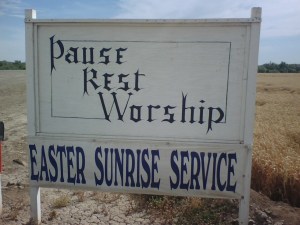
Pause. Rest. Worship.

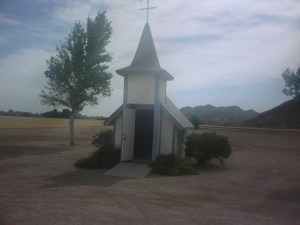
This was originally written shortly after I moved to Yuma. This little church got destroyed during that really bad storm a month or two ago–I really hope they are able to rebuild it.

I didn’t expect to find any beauty here in Yuma. I knew that living here was the right thing to do, and I never questioned my decision to come here from “America’s Finest City,” but the truth is, I never thought to see anything but cactus and dust, especially at work.

The funny thing is, it actually ended up being beautiful here. Driving to work in the springtime or just before a harvest is incredible. There are huge verdant fields on either side of 95, and they extend for acres. I have no idea what some of the crops are, but there is no denying the beauty of the fields.

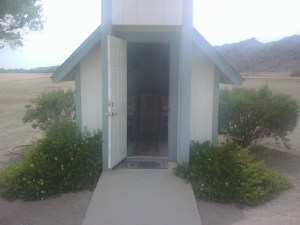
Right in the middle of one a few miles down from KFR where I work, there’s a narrow dirt road that leads to a tiny church in the middle of the field. It makes no sense that it’s there, but it is. And when I say tiny, I mean that this building is about the size of a very small house. But it’s complete with a steeple and a clean white paint job. I have not yet stopped there, but I plan to soon. There’s a sign near the road that entreats the reader to

Worship Sign

That sounds good to me. It’s a very long day here. Ten hours for now, but depending on where I am eventually assigned, it could be as many as six ten hour days, and possibly twelve or fourteen hour days on occasion.

Pause. Rest. Worship.  I believe I will, at least I plan to as soon as I get the chance.

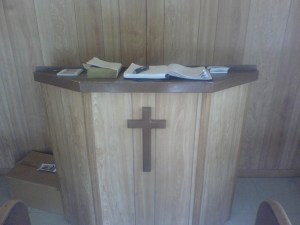
It turned out that my chance came just a couple of weeks later, when I got off work early. I drove slowly down the dirt road and parked just in front of the little church. I half expected the door to be locked, but it swung wide at my touch.

It was extremely hot in the little sanctuary, but the air was thick with both promise, and the Holy Spirit.

altar 1

Article 1

Article 2

outside 1

outside 2

pews 1

pews 2

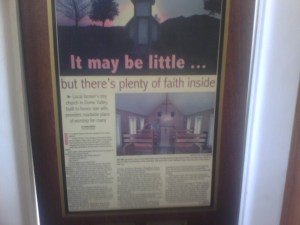
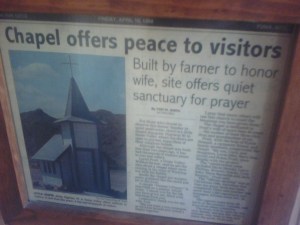
I didn’t spend a lot of time in the church–just enough to read the clippings on the wall, and sit in one of the small pews and pray for a couple minutes. I’d like to bring Jenny and David there at some point. There was just something about that place that struck a chord in me–something about the devotion of the man that built it. I think he would have been a good person to know. He may even still be alive for all I know.

Anyway, if you’re going down 95, and you have a few minutes to spare, I encourage you to

Pause. Rest. Worship.