Back on the Couch

It has taken me several days to process Friday’s events in Connecticut enough to get to a place in my head and my heart where I could write about it. I was in The Big Swirl frozen yogurt shop with John when I saw something on Twitter about a shooting.

Just then John tried to go behind the counter so we took off and headed over to GameStop to look for some Xbox accessories for David. John decided that would be a great place for a power dump, and it wasn’t until after I changed him that I sat in my car and read the story in full.

The magnitude of the tragedy was simply breathtaking, and I struggled to get my mind around it. What could have happened in this young, young man’s head that he could murder a class full of first graders?

In my mind I saw their faces as he came through the door, probably looking up in curiosity. As a parent my mind immediately went to my own third grade son sitting in his classroom, and two the toddler I’d just buckled into his car seat.

I wanted to be angry at the boy (because that’s really what he was) who had done this evil (because that’s it was), and I even expected to be mad at God for allowing it to happen but all I could feel to this very cold Sunday morning is a sadness so profound it coils in my guts like sickness. I think CS Lewis had it right when he said “no one ever told me grief felt so much like fear…”

I feel a grief of a level I haven’t felt since I was a teenager when I lost my parents and a good friend in my 16th, 17th, and 18th years. I didn’t know how to grieve that loss, and I don’t know how to grieve this one.

Clearly I didn’t know any of those children, but I grieve for them just the same. I grieve for their families. I grieve for what could have been. I grieve for the loss of so much innocence all at once.

I grieve for the teachers and faculty who died trying (some successfully and some not) to protect their students. I grieve for their families.

I grieve for the family of the murderer as well. The love they felt for the killer is no different than what the parents of the murdered children feel. Plus, this young man’s father has to live with what his son did and wonder where he fell short for the rest of his life.

I grieve for the country I love as well, because I feel this tragedy will not pull us together but further apart. It will be gun control vs gun owners and it will not stop.

I grieve because I know something like this will happen again.

I don’t blame the gun, or the killer’s mother for owning the ones used that morning. I don’t blame God or anyone else. God didn’t pull the trigger so many times Friday; a man did. I’m not going to get into the gun control debate today and maybe not at all, but I will say this (and I grieve the loss of my own innocence as well):

I own a gun. I bought it to shoot at targets. I have no plans to shoot any living thing.

But I would put a hundred bullets into the young man who did this thing to protect even a single child and I would be able to live with myself.

I read an excellent post by Morgan Freeman (find it on the Internet) which apportioned blame to media influenced sensationalism and I think that’s true, but not the only truth.

I think we’re failing our kids on a regular basis. So many have lost the idea that life is precious, and what binds us to it is little more than gossamer thread. Violence and violent imagery is ubiquitous. We expose our kids to it and we expose ourselves to it. It makes me despair for people. It makes me think there’s nothing to be done for the world. It makes me think there’s nothing anyone can do, the world is speeding to a sad and inevitable end.

It makes me think there is no hope.

There is hope, and that hope came to earth two millennia ago in a humble and quiet manner.

The hope for humanity is in the form of an obscure Nazarene carpenter who wore humanity for 33 years before dying for it. Our hope is not in a victory that can be achieved by strength of arms, though it is by blood.

We can’t change the hearts of our children, but we can tell them about who can. We can teach them to love like Jesus did. We can teach them every single life means something. We can teach them of the quiet heroism of school teachers and janitors.

I think if we just pour love into our kids then maybe we have a chance against this sort of thing.

Back to this morning. John woke up at 0600, and I brought him out to the couch. I skimmed through Twitter and Facebook, reading news stories about the shooting and people’s status updates about their lives, which carried on. Mine will, too.

Then I saw a picture, and it just wrecked me. It was a painting, really, on a post that was a poem with the rhyme structure and meter of ‘Twas the Night Before Christmas.’

In the painting, Jesus sat in a classroom surrounded by children, and a teacher was reading to her students from a children’s book.

There will be more pictures in the days to come. Many words will be spoken and written, and not all of them will be loving.

I think the thing to remember is that everyone grieves differently, and we should allow them that. Some will cry, some will pray, some will be angry. Some will curse God or call for the weapons of all gun owners.

We need to let people process their grief in their own way, and then we can move on.

We need to talk about a lot of things.

20121216-074925.jpg

The Third Man

They strapped the cross to his arms with two pieces of roughly woven rope, and cut off the extra with their knives. The shorter piece of wood rested across his thin shoulders, and was pegged into a deep groove in the longer piece, which would have rested along his back if it had been a couple of feet shorter. As it was, the wood left a gouge in the dirt behind him as he walked.

It was heavy, Dismas thought; perhaps half a man’s weight, maybe a little less. The Romans used good wood.

A man he didn’t know balanced a slightly larger piece of wood across his torn and bloody shoulders as he walked (though it was really a little more like a controlled stagger), and his former “partner,” Gesmas, directly behind.

The thought that it was Friday occurred to him, along with the knowledge that on the morrow, the roads into and out of Jerusalem would be choked with people again. There would be much opportunity to procure coin, and then wine. This was followed by the thought he’d robbed his last traveler, and that his small curved knife had been taken by the Romans at his capture. He was helpless as a baby.

Dismas glanced at the jeering crowd gathered around the three of them and after a moment realized their taunts and cries were not directed at either him or Gesmas; they were focused on the third man. There were so many of them, and as they began their final walk, the crowd followed along.

He didn’t want to think about the hill that waited at the end of the rocky trail, and that soon enough he would be hanging from the rough wood now bouncing against his shoulders, with crows pecking at his rotting corpse.

He walked, and his feet kicked up little clouds of dust. The straight portion of the cross dragged heavily behind him.

The soldiers mostly left he and Gesmas alone as they walked, but seemed very intent on making the walk of the third man especially brutal. They began striking him with short leather whips right outside the gate and continued every ten or fifteen steps. The man’s dingy robe was bloody from it.

Gesmas swore at the soldiers, swore at the third man, swore at the crowd. Sweat dripped from his brow and made dark spots in the dirt at his feet as he walked. Only one soldier even spared him a glance—more of a glare, really. He pointed his sword at Gesmas and said “Silence…”

Dismas thought about joining in the swearing. The thought of a quick death from a Roman sword did have its allure. He’d seen people hanging from crosses, of course. They died hard, unless the Romans broke their legs to speed things up. You couldn’t breathe as well if you couldn’t push yourself up on the nails. He’d heard it was like drowning.

He hoped they’d break his legs.

Gesmas just hung his head and kept walking, and Dismas did the same. You never cut off any part of your life—not even a second—if you had the choice.

The Romans continued to taunt the third man, and the rhythmic “thwack” sound of their whips striking his bloody back strangely took Dismas’s mind from his coming fate. The crowd walked with them, jeering—though he would sometimes hear a few cries of “Let him go” interspersed with the cries for the man’s death. And there was a large group of women amongst the crowd, who wept openly and reached out their hands toward the third man.

He wondered what the man had done to bring such violence on himself. It was like many of the people hated him. Dismas had heard of a man teaching throughout the region and beyond, a man called Jesus, but that man seemed revered—loved, even. Could this be the same person? He’d never heard one of the man’s talks, and had not set foot in the temple or made a sacrifice in quite some time.

Yet there was something about this man. He didn’t carry himself like other people. Dismas had yet to hear him speak so much as a word, but here he was. His robe was torn in the back from the whips, and something was twisted around his head and blood was running down his face.

The third man turned and looked toward the weeping women, and Dismas heard him speak at last.

“Daughters of Jerusalem, do not weep for me; weep for yourselves and for your children—“ His next words were drowned out by a chorus of cries from the part of the crowd that seemed glad to see him there, and Dismas suddenly wanted to hear more of what this man had to say.

He didn’t have the chance. Dismas saw the man slowly fall forward onto his face, and his cross slid forward onto the ground.

Do not weep for me, Dismas thought.

It had to be Jesus, this man wounded, and hurt, and covered with blood, and mud, and the spit of his guards.
He and Gesmas stopped and watched. The third man just lay there, and Dismas could see him spit blood onto the ground. Two of the soldiers sliced off the ropes binding the man to the cross and flipped it over onto the ground next to the man. They grabbed a another man who looked like a merchant out of the crowd, and lifted the third man’s cross from the ground and onto the merchant’s shoulders.

Two of the soldiers grabbed the man on the ground by the back of his robe and lifted him from the dirt. Dismas could hear the garment begin to tear, but the man still stood, wavering for a minute. The two soldiers mocked him, and joked among themselves and with the crowd about the third man’s seeming inability to stand without weaving. They pushed him back and forth between them, spitting vile profanities at him, stopping every now and then to slap him across the face or hit him with their fists.

He stood there swaying slightly, saying nothing and just absorbing their blows.

After a few more moments of their fun, the two soldiers with the third man and the rest of the squad got the procession moving again, onward toward the Skull.

Dismas followed at the rear, and watched the third man lead the column, with the merchant next, then the two soldiers with the whips, Gesmas, more soldiers, and then himself. They never touched Gesmas or him, but they continually harassed the third man, continued to beat and whip him, and when he would fall, they would kick him until he was able to struggle to his feet.

Dismas wondered for the first time what the man’s name was. Who was this man that took every blow with little more than a groan? Who was he that he could do that? He never begged them to stop, never pleaded for his life. He just walked calmly forward. He had seen a display of lambs in the temple court once waiting to be purchased for sacrifice, and this reminded him oddly of that.

At last, just as the sun was reaching its zenith, they reached the top of the hill. Dismas stood panting, his legs on fire from the climb, with the bottom of his cross resting on the ground. Gesmas stood there glaring at the soldiers and the crowd, looking like a trapped animal.

The soldiers jerked the cross from the shoulders of the merchant, and let it fall backward onto the ground. They pushed him away and he disappeared over the edge of the hill and back toward the city. The third man started to fall forward, but his two guards caught him under his arms, and then ripped his garment down the center, leaving him in his underclothing. They let him go and he fell forward onto his face.

The two guards assigned to Dismas turned his cross onto the ground, and then ripped his robe apart as well. Dismas stood in his undergarment, and then one of the soldiers barked at him “Lie down on the cross. Now!”

Dismas did as they asked, and felt the rough wood dig into his back. Absurdly, he thought of splinters. As they stretched out his arms along the crossbar, he could hear the guards of the third man call out to him mockingly, and Dismas heard a final blow land somewhere on the third man’s body.

“Now, your majesty. Can you not free yourself? Command us to let you go, then…”

That was it, Dismas thought. The third man was certainly no thief, no murderer. He didn’t behave like anyone Dismas had ever met before. He just faced his death with absolute calm. There was just something about him that was different. Dismas had seen Herod one time from a distance, and he almost walked through people. Not just like he didn’t see them, but like they were not worthy of being seen. He just…strode.

The third man was not like that, not arrogant in the least, but was somehow regal all the same. Not like a lamb so much after all, Dismas thought. Then they laid the third man down on his own cross, and he spoke again. His voice was full of pain, but rang out like a bell in the still air on top of the Skull.

“Abba,” the third man said, “…father…forgive them, forgive them…they don’t know what they’re doing…they don’t know…”

His voice trailed off, and Dismas realized the man was praying, praying for the men about to hammer nails through his wrists and feet.

Just then Dismas felt the point of the first nail enter his wrist at an angle right through the center of the bundle of nerves at the heel of his palm. He could feel every strike of the mallet through his entire body. He hardly had time to stop screaming from the first nail before the second was hammered home. He didn’t feel the nail that went through both of his ankles and the cross.

And then it was done.

The soldiers looped ropes around the side of his cross and then raised Dismas up on the far right, sliding the base of his cross into a hole in the ground. They raised the third man up in the center, with Gesmas on the left. Gesmas was screaming profanities at the soldiers, at the crowd, and from what Dismas could tell, God as well.

The third man hung on his cross with his head down, and Dismas could see his chest rising and falling, rising and falling. A crowd began to gather in front of him, a weeping woman at the center, with a handsome young man standing next to her. An older man, one of the temple priests, pushed himself forward through the crowd, “He saved others; let him save himself if he is the Christ of God, the Chosen One.”

The third man’s two guards came forward next. One of them pushed a piece of sponge onto the head of his spear and then sunk the spear into a nearby bucket. He held the dripping weapon up to the third man as he hung there but the man just shook his head. The second soldier lifted a sign on his spear and hung it over a nail protruding from the top of the third man’s cross. He cleared his throat and read aloud “Here is the king of the Jews.”

He chuckled and slapped his partner on his armored shoulder. “If you are the king of the Jews, save yourself,” said the soldier in a voice dripping with sarcasm.

Gesmas inclined his head over to the right and screamed at the third man, “Aren’t you the messiah? Save yourself, then. Save us!”

Dismas looked at the man on the middle cross. His head hung low, and blood ran down his cheeks into his beard. His chest and ribs were bruised and striped from the whips. One leg was positioned on either side of the cross with a long nail driven through his left ankle, through the wood, and out the other ankle, where one of his guards had bent the end over so the third man’s foot couldn’t slip off. He struggled for breath.

And then truth rushed through Dismas’s mind like a cold river—this man, the third man, was king, and the promised messiah. He knew it with absolutely certainty, and at that moment, awareness of his sin came crashing into him and through him. He saw the first purse he grabbed. He saw all the men he’d killed—saw their faces flash before him, and he knew that he could not go into the darkness of death with the weight of that sin coiled around his heart.

He somehow knew the third man—this Jesus—could take it away. He knew he could carry the weight for him, into His father’s kingdom. He leaned his head forward as far as he could, and turned toward Gesmas.

“Don’t you fear God?” he shouted. “You’re under the same sentence as him. So am I. We’re getting the reward our deeds demand.”

Dismas inclined his head toward Jesus. “This man has done nothing!!”

Gesmas fell silent.

Dismas saw Jesus turn his head toward him and turned his head as far as he could to the left so he could look into his eyes. They were filled with kindness, and tears for the people that Dismas knew he longed to save. He lowered his head.

“Jesus…”

He could feel Jesus looking at him, and he raised his head again. Everything else disappeared—Gesmas, the crowd, his cross. There was only Jesus, his brown eyes filling, and looking at Dismas clearly in spite of his own pain.

“Jesus,” he pleaded, “remember me…remember me when you come into your kingdom.”

“Amen, I tell you,” said Jesus. He smiled at Dismas and his smile was beautiful, even with blood running down his face. “Today you will be with me in paradise…”

A feeling of peace ran through him, and he looked up at the sky. The pain was distant, and it occurred to him that the end was very near. Clouds gathered over the Skull, blowing back toward the city. He looked down at the crowd and two soldiers were coming toward him with mallets.

He didn’t feel it when they broke his legs.

Finding Our Night-Night Place

Here I am again on the couch. John woke up at 430, exactly when I did–maybe he heard my alarm. I get up that early so I have time to have breakfast, and throw lunch together or take a shower. More importantly, that’s my morning devo time.

Well, trying to get a semi-fussy toddler back to sleep precludes all but the last of those things. And so it was that I ended up in my spot with a baby on my shoulder, and talking to God.

I spoke softly, but I did pray aloud, and it wasn’t until he heard the sound of my voice that John stopped squirming and started going back to sleep.

I think we do that, too. Sometimes life makes us squirm–life, in all its messiness with all its pitfalls and all its pain.

We get so caught up in whatever is going on it’s hard to calm down. This morning John needed a few things to calm him down and get him back to his “night-night” place. Sometimes we need that, too.

I think most of all, it was the sound of a calming voice (I prayed over him and sang softly into his ear) and the feeling of comfort that comes from feeling daddy’s arms.

That’s what we need, too, sometimes. We need to hear daddy’s voice and feel his love.

I think that looks and feels a little different for everyone. With some people, that love manifests through reading scripture. For others, it comes from hearing his voice through song, or from the gentle breeze of his voice through prayer, or maybe some other way.

It’s different for everyone.

The world and our troubles can fall away when we allow ourselves to hear from our abba, however he speaks to us.

So amazing when that happens. This morning, it happened for John, and for me through a fussy baby. The night before, I got to carry David back to his bed (won’t be able to do that much longer!). Anyway, I won’t get back to my night-night place until after practice tonight, unfortunately.

My Alabaster Jar

I woke up this morning (way too early, thanks to John), and I was still thinking about church last night. Specifically, the music. Perhaps it was that in conjunction with a video I watched earlier in the day:

(Zeb posted this a month or so ago. It inspired me then and inspires me now)

I watched that again yesterday afternoon while Jen was getting her toes did, and I was still thinking about it when we got to church and Jorge sang this song during communion:

I started thinking about truly dedicating my life to something, and what that actually meant.

here I am, take me…

When I got married, I dedicated the rest of my life to being with my wife in all circumstances, forsaking all others. I think it is very much like that when you offer yourself and your service (such as it may be) to Jesus.

I suppose that’s why the church is often referred to as “the bride of Christ.”

I tell myself that my natural affinities would not be useful to Jesus, and that he would never be able to use me for anything of consequence. This morning I realized Jesus doesn’t much care for our natural affinities. If we ask him to use us, he will.

A single lyric from this song popped into my head when that last sentence ran through my mind:

here I am, God, use me, set me aflame

I don’t have much to offer. I don’t have anything of worth. I’m no preacher, no evangelist. I’m getting a little long in the tooth, and lots of things hurt in the morning.

But I don’t want to waste another second of my life taking salvation for granted and serving my own ends first.

here I am, take me…

Better Questions

I started writing a blog post this morning and then decided to scrap it and just see what people thought instead. Several questions have been occurring to me lately:

1. Provided the Gospel is rightly presented, do we have to “do church” the way it’s always been done?

2. If we do church the way it’s always been done has that placed more emphasis on liturgy and less on the prompting of the holy spirit?

3. Can we do church differently and still represent God properly?

4. Can we shift our emphasis from trying to please people to trying to reach people?

5. Can we go places we haven’t gone and do things we haven’t done in the interest of bringing the Good News to people that haven’t heard it?

6. Is our corporate “packaging” of the Gospel turning people away from it?

7. If it is, can we change the packaging but not the gift?

8. Can we worship (musically) with different instruments than we normally do?

9. Can we play non-traditional music and still worship?

10. What does proper worship look like?

11. What would happen if we stopped doing church and started being church?

12. What if everything Jesus said was true?

13. What if we loved people as they were and stopped trying to change them and instead let God do it?

14. What if we let go of our inhibitions about how we worship and just started worshipping?

15. What if we taught our kids how to live by teaching them how to love?

I could keep going forever, but I think John is ready to be awake, which means I’m going to need both my hands to start cleaning up messes and putting out fires.

What are the answers to all my questions? I think that would be different for everyone. Personally, I have better questions than I have answers, but I’d welcome hearing yours. Dialogue is a good thing. I’ll leave you with a picture of John doing what he does best: little boy mischief.

20121208-071554.jpg

Imago Dei

This morning I had what an alcoholic might call a moment of clarity. It’s so interesting how God chooses to speak to us sometimes, and how our minds, and hearts and souls are awakened to his truth.

This is what happened today.

I was nearly out of gas, so I stopped at the Circle K on 24th Street and Avenue B to gas up and get my daily dose of caffeine (in the form of a 44-ounce Coke Zero). While I was walking from the gas pumps to the door, a beat up little Toyota hatchback pulled up right in front of the doors and two men got out.m

They were wearing some kind of coveralls, but looked like they came straight out of the exercise yard at Chino. Both men were extremely muscular and had braids halfway down their backs. They had tattoos peeking out of their sleeves and collars, and definitely had the intimidating look down perfectly.

One of the men went directly inside, and the other just sort of stood out front. He gave me a barely perceptible nod as I walked past him to go in. I immediately thought they were going to rob the place.

I went over to the soda machine and there was convict number one. He was filling a 44 ounce cup to the very brim with Blue Raspberry Icee.

He paid his .88 cents right before I did, then the two men got in the beat up Toyota and went on their way.

On my way to work I heard this song:

A line from the chorus stuck in my head: there could never be a more beautiful you.

What occurred to me was those
men at the Circle K were beautiful to God. With their tattoos and muscles and braids, they were beautiful to God.

Then these things occurred to me:

1. If they were beautiful to God, that meant I was beautiful to him, too. Even with my scars, and messed up skin, and pelt of hair I am beautiful to God.

2. I was made in his image, according to Genesis. So were the guys at Circle K.

3. Just because I do not always see beauty in things does not mean it isn’t there.

What does it mean to be made in the image of Christ? As usual, I went online and I found this definition:

“…The term Imago Dei (Latin for Image of God) refers most fundamentally to two things: first, God’s own self-actualization through humankind; and second, God’s care for humankind. To say that humans are in the image of God is to recognize the special qualities of human nature which allow God to be made manifest in humans…”

To me that suggests that our outer image really doesn’t matter that much, at least not to the extent we think it does. Certainly not to the extent by which we judge others, and judge beauty.

With that in mind, I think how we treat others–least of these or otherwise–is how we reflect either our image of God or our image of ourselves.

Put another way, If we treat people like crap it’s often because we feel that we ourselves are worthy of the same. Consequently we judge people based on our image of ourselves whether it be negative or positive, and we treat them according to our self-based perception.

I thought the men at Circle K were thugs because they fit into a thug-shaped box in my tiny little brain. Maybe some people see me and feel I fit into a box, too?

I was wrong, and they’re wrong, too.

I can’t say that I’ve ever felt like a standard bearer for Christ. It doesn’t matter. If I bear his name then I bear his image, too.

I need to pray for clearer vision, and truth in my perception of others. I need to act with imago Dei in mind, not imago Tom.

20121203-084658.jpg

I Have Decided

John woke up at 530 today, and like so many other times we ended up on the couch with him snoozing and breathing gently on my shoulder-those little puffs of baby breath more precious than gold. I do some of my best thinking and praying while holding babies or maybe just watching the kids play sometimes.

This is what occurred to me today. As a believer, I may not have the understanding of my San Diego family, at least as far as them believing what I believe, or not sometimes thinking I may have imbibed a little too much of “the Kool-Aid.” I may not have the support of much of the country, because it certainly seems to be trending toward Godlessness. For my own part–because I am not perfect–I may even have doubts sometimes about the goodness of God, especially when I see some of the jacked up stuff going on out there in the big, wide, ugly world.

But the young man I am holding needs me, and trusts me, and looks to me to know how to live. The one sleeping down the hall does, too, even if we struggle sometimes.

The woman sleeping in our bed, in our home, in the life we’ve made for ourselves loves me, too. She needs me to be capable, and Godly, and strong. On my own, I am none of those things.

I am weak, and callow, and filled with all manner of vile things.

But I am not on my own, not since March of 2000.

That’s when I decided I needed a savior.

For my family, for my home, for my future, for myself, I had to (and have to) make a decision for myself, even if it means a lot of things in my life will suffer because of it:

Supper on the Moon

I realized this morning I wrote this a while back and forgot to publish it

I was sitting on the couch reading a book a few months ago when my wife told me Neil Armstrong died. I can’t say that it affected me emotionally, because I clearly didn’t know him. I was one year old when he and Buzz Aldrin touched down on the moon’s powdery surface.

I took to the interwebs to find more info, and I saw a link from Eric Metaxas (the author of Bonhoeffer and Amazing Grace) on Twitter about the lunar landing, and it caught my interest because it wasn’t about the typical “One small step for man…” speech.

What I found out was Armstrong took communion on the moon, and that blew my mind. As Metaxas pointed out, some of the first words spoken on the moon were the words of Jesus Christ.

They weren’t broadcast over the radio, though Armstrong was prepared to. At the last minute he was told not to do it because of the legal battle NASA was already fighting over some scripture the Apollo 8 crew read from Genesis.

Yet Armstrong nonetheless took communion, and read from the scripture. On the surface of the moon, before they stepped out of the lander. That’s pretty amazing.

You can read Eric’s excellent blog here

Casual Blasphemy

I figured something out today.

The President is not the anti-christ. He’s not the savior, either. He’s just a man. He gets up in the morning, and he goes to bed at night. By all accounts he loves his family in the same way you love yours. He eats, drinks, and goes to the bathroom.

He’s a man.

I think that’s part of the problem. The President is so beloved by the largely liberally slanted media and the Hollywood “lobby” that he’s been almost deified, in a sense. He was elected because his promises appealed to more people than the other guy. Twice. This is the way of elections. President Obama won fair and square both times. Move on.

When I saw this clip on YouTube:

of Jamie Foxx calling the President “our Lord and savior,” I wasn’t particularly offended as a believer because I recognized the statement for what it was: a clearly misspoken and probably taken out of context remark that was likely meant with at least some irony by mssr Foxx. At least I hope so. It’s difficult to imagine anyone actually believing President Obama is anyone’s savior. Yet I do think Foxx’s words, spoken casually, are symptomatic of a larger problem.

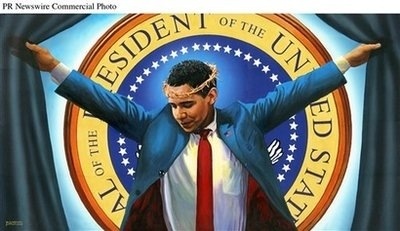
This morning I saw a representation of this painting online, called “The Truth.”

20121127-075211.jpg

The artist, Michael D’Antuono, has said his intent with the painting was to provoke political dialogue and that he meant to display the painting in a mock voting booth.

I can only speak for myself, of course, but to me this isn’t so much about the artist having the constitutional right to say whatever he wants: he has that right. I think he knew exactly the kind of reaction a painting of this nature would provoke in the “religious right,” and painted it with that in mind. He got the reaction he wanted, along with a large bowl of controversy. I’d imagine he probably sold a few tickets to art exhibits as well.

Back to my original point: President Obama is a man. He’s not the savior. He’d certainly acknowledge that himself. He’s not a hero, either. Most people aren’t. His election (both times) was certainly ground-breaking and showed how far our country has come.

Yet as I mentioned earlier, The President was elected based on what he said he would do. He was also elected based on who he was and what he represented.

The media and Hollywood has created this…cult of personality around him. We allowed that to happen. We encouraged it. We still do.

He’s a man, people. A smart and gifted one, but he can’t fly or lift cars over his head. He can’t save anyone, maybe not even the country. Salvation (and deliverance) lies elsewhere, and we as a people have to be careful of the burdens and expectations we place on our public servants.

Still, I look at the crown of thorns in D’Antuono’s painting and what I feel is not so much outrage as sorrow. He clearly does not understand what it represents. I wonder if he truly understands what his painting represents?

It’s not just oil and pigment. If there are actually people out there who believe the President to be something he is not (such as a savior), they are worshipping at an altar they want no real part of.

Just because the constitution gives people the right to say (and paint) stupid things does not mean they should. Casual blasphemy is still blasphemy, and whether or not you believe it does not matter. Think of the outrage if Muhammed had been mocked depicted instead of Jesus.

Then again, no one really thinks twice about offending Christians.

John 15:18 says, “remember if the world hates you that it hated me first.”

I read this commentary about the above verse, and I thought it was interesting:

If the world hates you – As the followers of Christ were to be exposed to the hatred of the world, it was no small consolation to them to know that that hatred would be only in proportion to their faith and holiness; and that, consequently, instead of being troubled at the prospect of persecution, they should rejoice, because that should always be a proof to them that they were in the very path in which Jesus himself had trod. Dr. Lardner thinks that πρωτον is a substantive, or at least an adjective used substantively, and this clause of the text should be translated thus: If the world hate you, know that it hated me, your Chief. It is no wonder that the world should hate you, when it hated me, your Lord and Master, whose lips were without guile, and whose conduct was irreproachable….

I think we need to expect mockery, and much worse. I think the world is changing, and quite obviously turning away from God.

It makes me sad, but also resolved. There is much work to do, and we as believers have much responsibility.

Politics and the rhetoric that comes with them really don’t matter in the end.

Jesus does, and what we do with Him.

I Would Do Anything

I can’t think of anything worse than when the kids are sick. Not because it’s typically messy, or gross, or I don’t like cleaning up their puke or their snot or their (literal) crap. Not because of what it does to me.

Because of what it does to them.

Their playfulness becomes helplessness in the face of whatever is making them sick. Their joy is replaced with fever, or coughing, or whatever their symptoms are. It sucks worse than just about anything.

When the boys were sick last weekend there was a point where David had just gotten done throwing up in pretty much every room of the house and John was coughing like crazy. Jen was in the bedroom dealing with her own flu and I had just gotten the boys chilled out and resting.

20121121-064122.jpg

20121121-064139.jpg

I remember thinking I would gladly bear their illnesses if it were only possible. I would do anything to assuage their suffering.

I thought that again just now, at 0644, on the day before thanksgiving. I’m holding John as he sleeps and praying the antibiotics do their thing and we don’t need to take any more drastic measures, like the hospital.

I would take his pneumonia in a heartbeat and I would bear it gladly.

The conviction that just slammed into me is that’s how God feels about us. Ultimately, he didn’t just cure our illness (which was terminal). He gladly bore it for us, and he experienced everything on our behalf. He bore all, and suffered all, and he died.

God died.

For me. For my sons.

I can feel the baby breathing against my chest as I thumb type this, and I’m thinking about how much God loved the world.

20121121-065733.jpg

I think about how much I love my kids, and that I would stop at no length to protect them from anything. I would be sickened, or beaten, or humiliated, even killed. I would literally do anything for them.

That’s what Jesus did.